The cloud is a lie
We talk about the cloud as if our data floats somewhere above us. It does not. The only wireless part of your internet is the short hop from your phone or laptop to a nearby antenna. After that, nearly everything travels through fibre-optic cables on land — and then, for any message that crosses an ocean, down a glass tube on the seabed.
The International Telecommunication Union puts the figure at more than 99% of international data traffic. Satellites matter for remote places, ships, aircraft and emergencies, but for the enormous, sustained flows of data between continents, they cannot compete with a cable on capacity, cost or speed. Your video call to another continent, the bank transfer, the film streaming from a server overseas — all of it, at some point, is light inside glass under the sea.
A century and a half of cables
The idea is older than the internet by more than a century. In 1858, engineers completed the first transatlantic telegraph cable between Ireland and Newfoundland. Queen Victoria sent a message to US President James Buchanan. The cable carried only a few words an hour and failed within weeks — an operator pushed the voltage too high and damaged the line — but it proved the ocean could be crossed. A durable cable followed in 1866, and telegraph lines multiplied through the rest of the century.
Voice came next. The first transatlantic telephone cable, TAT-1, went into service in 1956. It could carry 36 simultaneous calls between North America and Europe, and a three-minute call from New York to London cost about $12 in 1956 money — several days' wages for most people. Copper had a ceiling: every doubling of capacity meant thicker cable and more repeaters.
The break came in 1988, when TAT-8 became the first fibre-optic cable across the Atlantic. It carried 280 megabits per second — roughly 40,000 simultaneous phone calls, more than a thousand times TAT-1's capacity, on a cable about the same physical size. Light, not electricity, was now doing the work, and the economics of the modern internet suddenly existed.
How light crosses an ocean
A modern submarine cable is, for most of its journey, about as wide as a garden hose. Inside it are strands of optical fibre no thicker than a human hair, made of glass so pure that — as one engineering explainer puts it — if seawater were as transparent as telecom-grade silica, you could see the bottom of the Mariana Trench from the surface on a sunny day.
Lasers convert electrical signals into pulses of light, and the light is trapped inside the fibre by total internal reflection, bouncing along the glass core for thousands of kilometres. Because even the purest glass dims the signal, small pressure-housed repeaters sit every 50 to 80 kilometres along the route, boosting the light back to strength without ever turning it into electricity. Power for those repeaters travels down a copper conductor inside the cable, fed from the shore stations at either end.
The capacity is hard to picture. A single hair-thin fibre in a modern cable can now push more than 20 terabits per second, and a cable typically bundles 16 to 24 fibre pairs. One cable can move well over 300 terabits per second — several times the entire streaming output of Netflix at global peak, through a single garden-hose bundle.
What breaks them
Given what they carry, the cables break surprisingly often — and surprisingly mundanely. Roughly 150 to 200 faults occur worldwide every year, according to the International Cable Protection Committee. About 70 to 80% of them come from accidental human activity, principally commercial fishing and vessel anchors. Trawlers drag nets along the seabed; anchors drag across it. Sharks occasionally bite cables, but they are not a significant source of damage, and deliberate sabotage, while it happens, is rare compared with routine maritime accidents.
Most faults pass unnoticed, because the network has redundancy: traffic is redirected onto other cables in fractions of a second. The danger is where alternatives are scarce. When Tonga's single submarine cable was cut by the Hunga Tonga volcanic eruption in January 2022, the country of roughly 100,000 people spent five weeks reduced to a trickle of satellite bandwidth. Banks stopped clearing. Remittances from Tongans working abroad could not arrive. The economic hit was estimated in the tens of millions of dollars — for one cable break in one small nation.
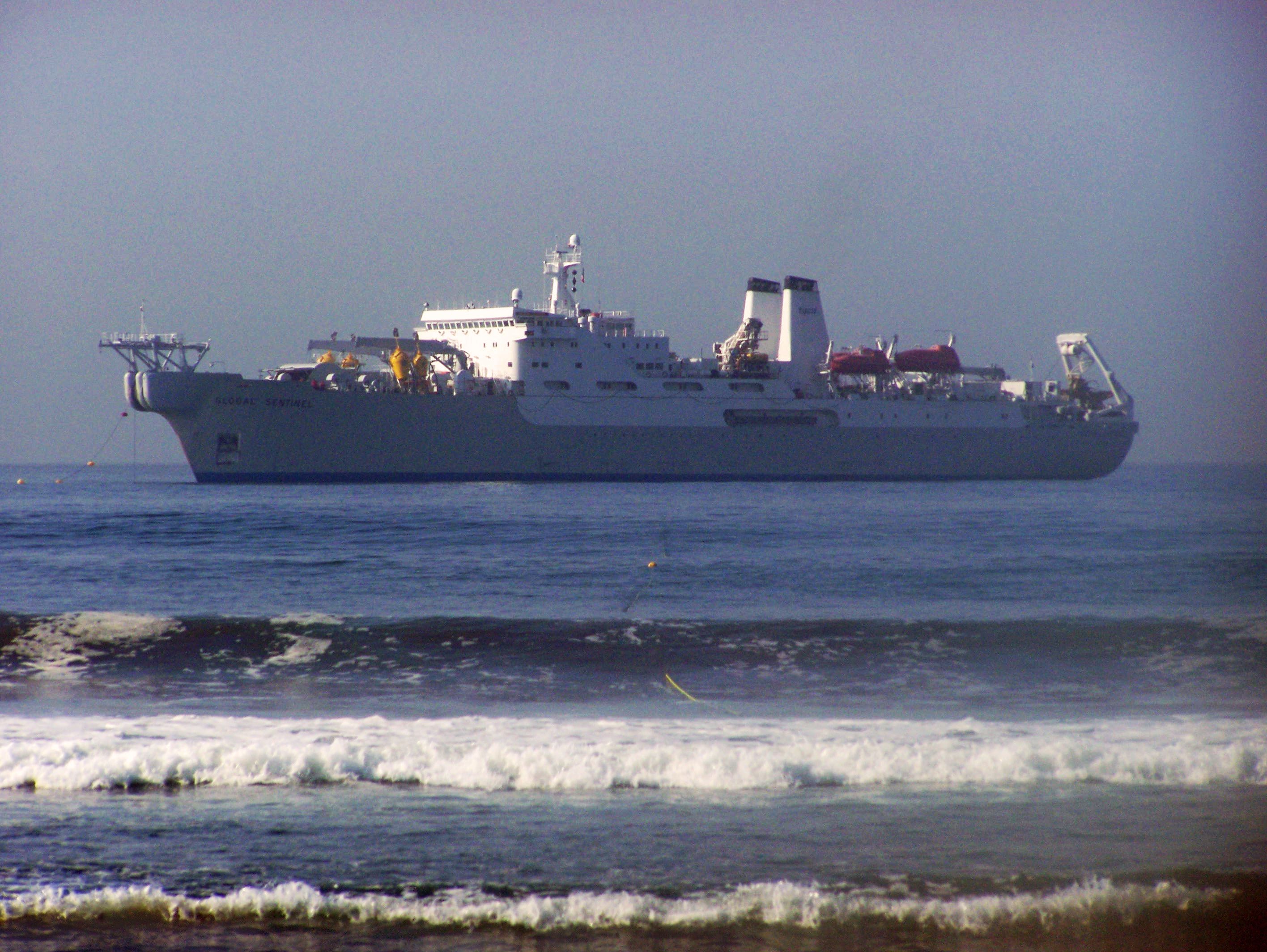
Fixing a break is a slow, specialised operation. First the fault is located from shore, then a repair ship sails to the spot, lifts the cable to the surface, cuts out the damaged section, splices in a replacement in a shipboard clean room, and lowers it back down. A single repair takes one to three weeks on station — and getting there can take longer. The ITU's July 2026 resilience report found that average repair response times rose from under 20 days in 2012 to more than 50 days in 2024, with permits, customs and restrictions on foreign vessels contributing to the delays. Around 70 vessels worldwide technically have cable repair capabilities, but only about 20 to 25 are dedicated or contracted to repair work long term, and much of the fleet dates to the 1980s and 1990s. A new purpose-built vessel can cost between $100 million and $150 million.
The narrow places
The network's real weakness is not any single cable but geography. Cables connecting major markets converge through narrow maritime corridors, and redundancy provides far less protection when the alternative cables share the same physical route.
The starkest example is the Bab el-Mandeb Strait, between Yemen and the Horn of Africa. At least 17 cables carrying an estimated 17 to 20% of global internet traffic pass through a waterway that narrows to less than 14 miles, and more than 90% of communications capacity between Europe and Asia passes through the Red Sea and Suez corridor. In early 2024, three cables in the Red Sea were cut in quick succession, briefly slowing internet traffic between Europe and Asia; the most likely culprit, according to subsequent forensic reporting, was the anchor of a cargo ship drifting after a missile strike.
Similar concentrations exist at the Strait of Hormuz, the Strait of Malacca, and at cable landing stations — the buildings on shore where fibre meets the terrestrial network — which cluster in a handful of places: Marseille, Fortaleza, Mumbai, Singapore, Fujairah. More than 80% of new submarine cable investment flows toward established routes, according to the ITU, increasing capacity without necessarily providing geographic redundancy.
Who owns the pipes
The ownership of this infrastructure has changed as quietly as the technology did. International cables were traditionally financed by consortia of telecommunications companies. Today the biggest builders are the hyperscalers: Google has stakes in more than 30 cables, Meta co-owns 2Africa — at roughly 45,000 kilometres, the longest submarine cable ever built, linking 33 countries around Africa, Europe and the Middle East — and Amazon and Microsoft are close behind. Four US technology companies — Amazon Web Services, Google, Meta and Microsoft — now account for more than 70% of international undersea cable capacity, according to a 2026 Council on Foreign Relations analysis. A little over a decade ago, the same four accounted for less than 10%.
Concentration extends to the supply chain. Four companies — ASN, NEC, SubCom and China's HMN Tech — account for more than 95% of global production of specialised submarine cable equipment, according to the ITU. Governments have begun responding: in June 2026 the US Federal Communications Commission tightened submarine cable rules and required operators of equipment connecting undersea systems with American terrestrial networks to obtain licences for the first time.
The one continent left out
As of February 2026, Antarctica remains the only continent with no submarine cable link. Everywhere else, the network keeps growing — more than 600 active systems, more cables planned every year. But the lesson of the last few years is that building more cables is not the same as building a more resilient network. A cable's theoretical maximum capacity is not the same as its activated capacity, and a dozen cables through one strait are, for practical purposes, one point of failure.
The internet feels decentralised because its data can be redirected in fractions of a second. Underneath, it rests on glass tubes on the seabed, laid and repaired by a fleet you could count on your fingers and toes, crossing narrow seas and coming ashore at specific points on specific coasts. It works, almost all the time. Every message you send abroad tonight will pass through it.


Comments (0)
Comments are reviewed before they appear on the site. Your email address is never shown publicly.
No comments yet — be the first to share your thoughts.