A rift that became a lake
Baikal lies in southern Siberia, within Russia's Buryatia republic and Irkutsk region, in a deep structural hollow where the Earth's crust is slowly pulling apart. That rifting is the secret of its age: as the basin keeps subsiding, sediment cannot fill it faster than it deepens, so the lake has survived for tens of millions of years while ordinary lakes came and went.
The scale is continental. The lake runs 636 kilometres long, covers some 31,500 square kilometres, and is fed by more than 330 rivers and streams — yet drains through exactly one outflow, the Angara River. Its floor sediments may be as much as 6,100 metres thick: an archive of Siberian climate older than the human species.
How deep, how old — and why the numbers differ
You will see Baikal's depth quoted at several values, and the disagreement is a good lesson in how such numbers work. Britannica gives a maximum depth of 1,620 metres (5,315 feet) and an age of 20–25 million years. UNESCO's World Heritage listing describes it as the oldest (25 million years) and deepest (1,700 m) lake in the world — a rounded figure. Modern echo-sounding surveys are the source of the commonly quoted ~1,640 m value. The honest summary: about 1.6 kilometres deep, give or take a survey, and roughly 25 million years old.
By volume there is no contest at all. Baikal contains about 23,000 cubic kilometres of water — about one-fifth of the fresh water on Earth's surface, and more than all the North American Great Lakes combined.
The Galapagos of Russia
UNESCO calls Baikal the "Galapagos of Russia," and the comparison is earned. Between 1,500 and 1,800 animal species live in the lake, along with hundreds of plant species — and the majority of the species are endemic, found nowhere else. Isolation plus immense time equals evolution in a private laboratory.
The fish fauna makes the point: of some 50 fish species, the most numerous are the 25 species of gobies (sculpins), a group that has radiated through the lake's depths. Strangest of all is the golomyanka, a fish unique to Baikal that gives birth to live young rather than laying eggs — a rarity among fish, and one of the lake's signature endemics.
The seal that lives in a lake
Baikal's one mammal is its most famous resident: the nerpa, or Baikal seal (Phoca sibirica). It is the only species of seal in the world that lives exclusively in fresh water, hundreds of kilometres from the ocean its ancestors came from. How seals reached a landlocked Siberian lake remains a genuine evolutionary puzzle — the leading idea involves ancient river systems connected to the Arctic — but the nerpa is entirely at home, hunting golomyanka and other fish beneath the winter ice.
It is joined by more than 320 bird species in the Baikal area — and beneath the surface, an endemic fauna at every depth that scientists are still cataloguing.
Winter: a lake under glass
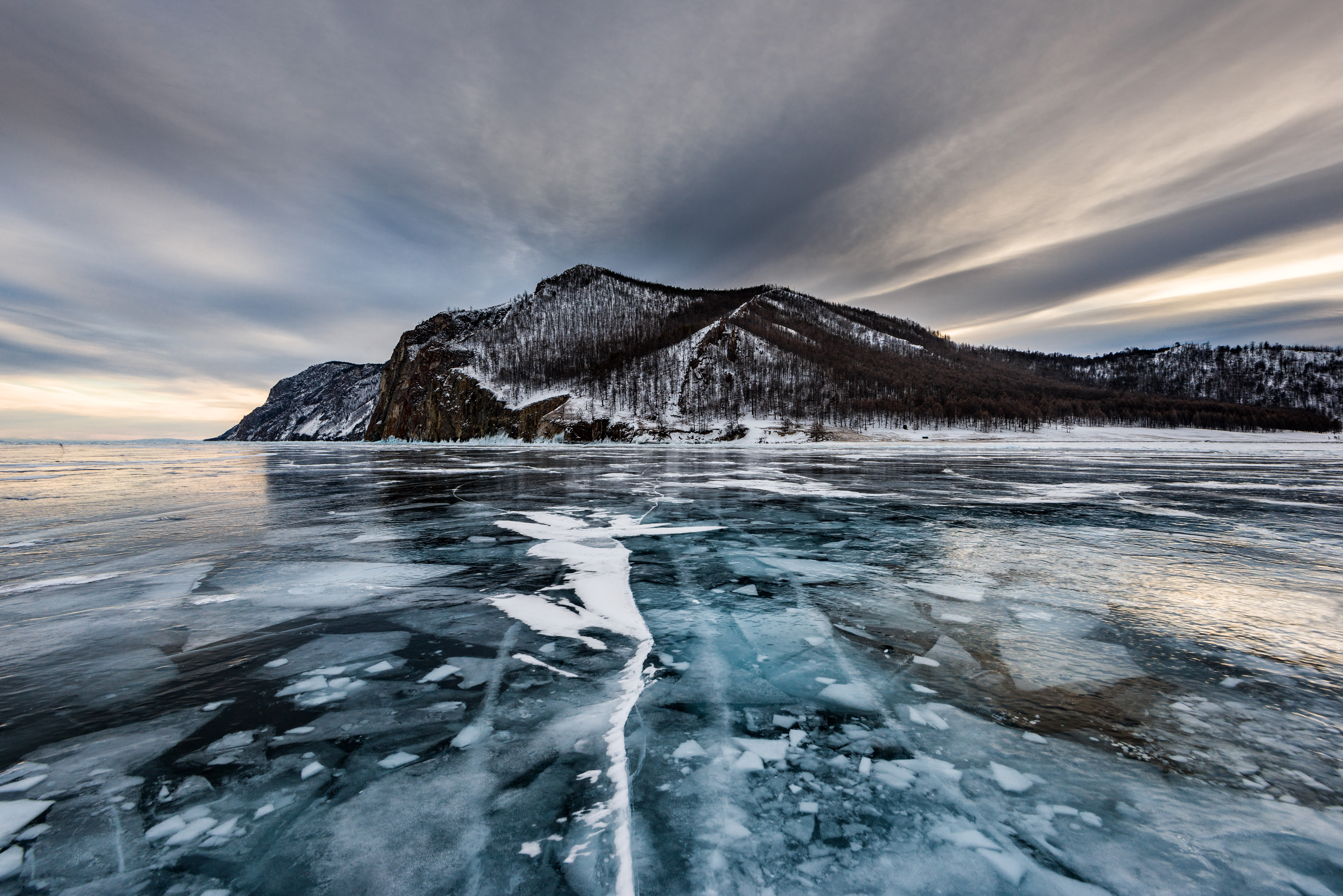
Baikal's climate is milder than the surrounding Siberian interior, but winter still takes the lake. The surface freezes in January and does not thaw until May or June. For roughly half the year the world's deepest lake is sealed under ice — clear enough in places that the water, which is transparent to about 40 metres in summer, seems to continue straight down through it. The nerpa depends on this ice: pups are born in snow dens on the frozen surface in late winter.
That dependence is now a pressure point. Britannica's assessment notes that climate change, by affecting ice thickness and duration, could affect the breeding and feeding habits of the Baikal seals.
A treasure under pressure
Baikal was designated a UNESCO World Heritage site in 1996, inscribed as the most outstanding example of a freshwater ecosystem on Earth. Protection has been contested for decades: a pulp and paper mill built on the southern shore in 1966 drew protests from Soviet scientists for its polluting wastes, and industrial pollution remained a concern long afterwards. The lake's clarity and its endemic species are the product of 25 million undisturbed years; the threats operate on a timescale of decades.
The deepest lake on Earth is also a reminder of what "old" really means in geology. Baikal was already ancient when the first hominins walked. The question its protectors are asking is whether it can stay that way now that we are here.


Comments (0)
Comments are reviewed before they appear on the site. Your email address is never shown publicly.
No comments yet — be the first to share your thoughts.