Some of the oldest evidence in the solar system falls out of the sky every day. Tiny grains of dust from comets and asteroids drift down through the atmosphere, and a few of them — the rarest and most precious — come from further away than any spacecraft has ever returned a sample from. NASA flies a converted spy plane through the stratosphere to catch them.
Now twelve of those grains have told a story scientists have suspected for decades but could never prove: that a vast reservoir of ancient ice, rich in heavy oxygen, has been sitting in the Kuiper Belt since the solar system was born — and that it stayed there, largely untouched, while the planets were forming closer to the Sun.
Catching dust at 65,000 feet
The dust was collected by NASA's ER-2, a high-altitude research aircraft that flies above 65,000 feet — more than twice as high as a passenger jet — through the stratosphere. At that height, the air still carries microscopic interplanetary dust particles, grains smaller than a grain of sand that have drifted in from space. The ER-2 carries collectors coated in silicone oil that trap them as it flies.
Researchers at NASA's Johnson Space Center in Houston, working with colleagues at the University of California, Los Angeles, analysed twelve of these particles. High concentrations of solar energetic particle tracks — damage left by charged particles from the Sun over millions of years — helped the team trace their origins to the Kuiper Belt, the doughnut-shaped region of icy bodies beyond Neptune that includes Pluto.
The team then examined the grains with advanced electron microscopy at NASA and an ion microprobe at UCLA, studying their minerals and the ratios of oxygen isotopes they contain. What they found inside those twelve specks of dust was a chemical signature no one had ever measured directly before.
What "heavy water" means — and why it matters
Oxygen comes in different forms, called isotopes, which differ in weight. Most oxygen is the lighter oxygen-16; a small fraction is the heavier oxygen-18. Water made with heavier oxygen is, in a sense, heavier water — and the ratio of the two in a sample is a fingerprint of where that water formed.
For decades, scientists have suspected that ice in the outer solar system contains high amounts of heavier oxygen isotopes. Earlier studies of meteorites and samples returned from carbon-rich asteroids offered clues, but the evidence remained limited — meteorites come mostly from the asteroid belt, closer to the Sun, not from the deep freeze beyond Neptune.
The twelve dust grains changed that. The researchers identified minerals that formed when water interacted with dust early in the solar system's history, and their chemical signatures show that the ancient water was enriched with heavier oxygen isotopes. In other words, the grains carry the fingerprint of the primordial ice reservoir itself — water that has been frozen in the Kuiper Belt for roughly four and a half billion years.
The finding also confirms a long-standing prediction of solar system chemistry known as photochemical carbon monoxide self-shielding — the idea that ultraviolet light in the young solar system sorted oxygen isotopes in a way that left the outer solar system enriched in heavy oxygen. The theory predicted the reservoir; the dust grains are the first direct evidence that it is really there.
A solar system that did not mix
The discovery is not only about water. It is about how the solar system put itself together.
Measurements from NASA's Genesis mission, which collected particles from the solar wind, provide a reference for comparing oxygen isotopes. Against that reference, the Kuiper Belt grains stand out — and the scarcity of similar signatures in meteorites tells its own story. If material had mixed freely between the outer and inner solar system, meteorites would carry the same heavy-oxygen fingerprint. They mostly do not, which suggests the giant planets — Jupiter, Saturn, Uranus and Neptune — acted as barriers, limiting how much outer material drifted inward while the planets were forming.
That matters because it changes how scientists think about where Earth's water came from. If the outer solar system's water stayed mostly in the outer solar system, then the water on Earth — and the water in you — more likely came from material that formed closer to the Sun, or arrived through a narrower channel than once assumed. The Kuiper Belt, in this picture, is less a reservoir that fed the inner planets and more a deep freeze that kept the solar system's earliest chemistry intact.
The Kuiper Belt: the solar system's attic
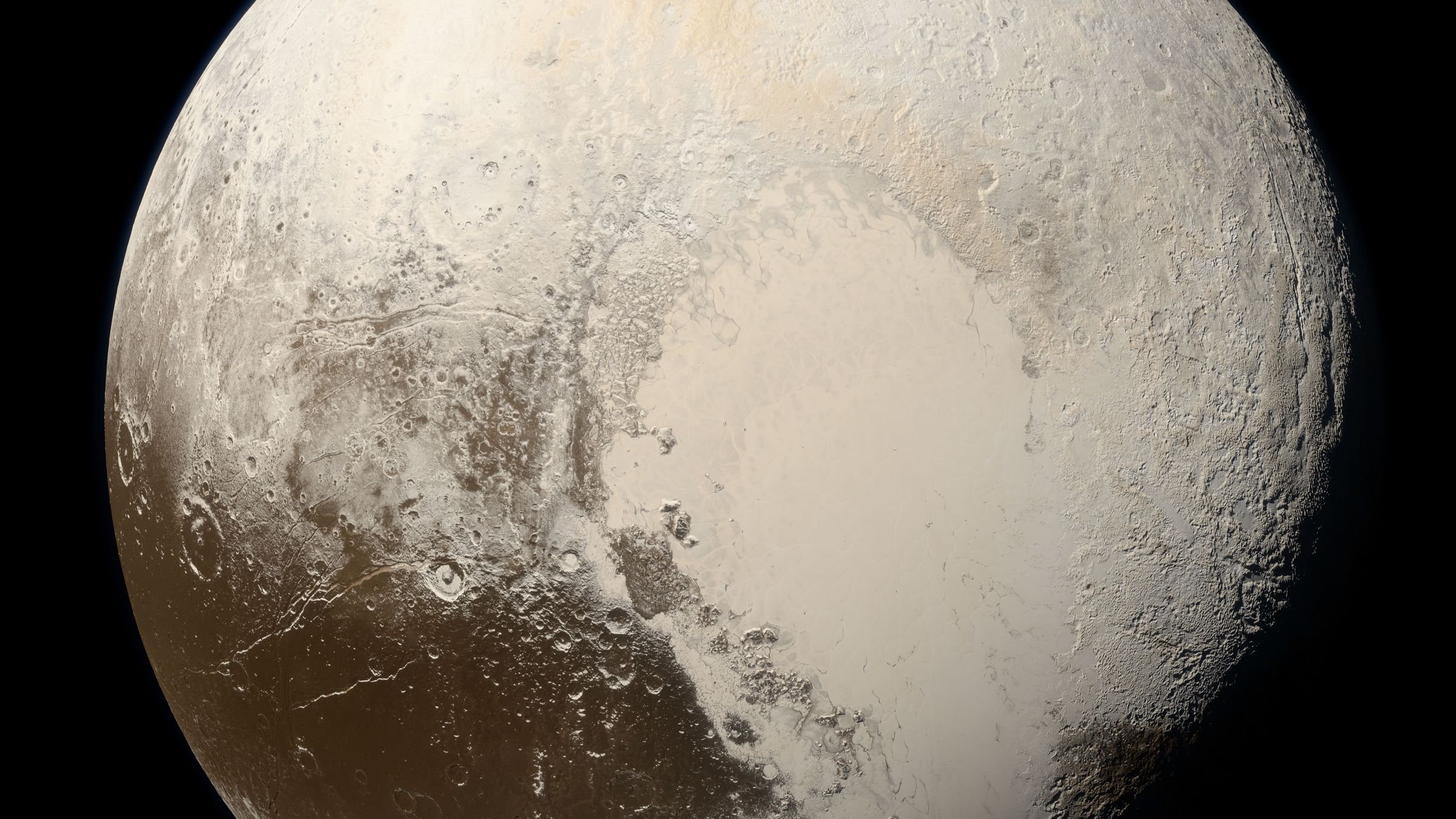
The Kuiper Belt is a vast ring of icy bodies stretching from Neptune's orbit outward, a region so distant that sunlight there is a thousand times fainter than on Earth. It is home to Pluto — the most famous Kuiper Belt object, photographed in stunning detail by NASA's New Horizons spacecraft in 2015 — along with dwarf planets like Eris, Haumea and Makemake, and countless smaller frozen worlds.
These bodies are leftovers: material that never gathered into a planet, preserved in the cold since the solar system's birth. That is what makes them so valuable to science. While the inner planets melted, mixed and resurfaced themselves over billions of years, the Kuiper Belt mostly just sat there, frozen — a time capsule of the original ingredients.
The catch is that no spacecraft has ever brought a sample back from the Kuiper Belt. New Horizons flew past Pluto and the small world Arrokoth, but it carried no sample return. The dust grains are the next best thing: fragments of Kuiper Belt material that made the journey to Earth on their own, caught by an aircraft flying through the stratosphere.
The journey of a dust grain
How does a speck of dust from beyond Neptune end up in an aircraft's collector above Earth? The journey takes millions of years. Collisions between Kuiper Belt objects chip off fragments, and sunlight itself slowly drags the smallest grains inward — a gentle braking effect called Poynting-Robertson drag, in which a dust grain absorbs sunlight and re-radiates it, losing orbital energy with every orbit until it spirals toward the Sun.
Most grains never make it. They are swept up by the giant planets, or fall into the Sun. But a few drift all the way into the inner solar system, where they meet Earth's atmosphere at tens of kilometres per second. A grain the size of a speck of dust is so small that it slows down high in the atmosphere before it can burn up, cooling as it falls — which is why the ER-2 can catch them intact in the stratosphere, still carrying the minerals and isotopes they formed with billions of years ago.
Every year, tens of thousands of tonnes of cosmic dust settle on Earth, most of it unnoticed. The twelve grains in this study are extraordinary not because they arrived, but because of where they came from — and because the scientists could prove it. The density of solar energetic particle tracks in a grain acts like a passport stamp: grains that spent longer in deep space carry more tracks, and the tracks in these twelve pointed to the Kuiper Belt.
What comes next
The study, led by planetary scientists Lindsay P. Keller and Christopher J. Snead of NASA's Johnson Space Center with Ming-Chang Liu and Kevin D. McKeegan of UCLA, was published in Science Advances under the title "A Primordial Heavy Water Reservoir in the Outer Solar System." NASA announced the findings on 18 November 2026.
The work opens a new way to study the outer solar system without the cost of a deep-space sample-return mission. NASA's Astromaterials Acquisition and Curation Office plans to open its next annual cosmic dust allocation cycle in early 2027, inviting university researchers to propose studies of these rare particles — including searches for organic molecules and noble gases that could say even more about the chemistry of the early solar system.
Twelve specks of dust, each smaller than the width of a human hair, have confirmed a reservoir of ancient ice that has been waiting beyond Neptune for four and a half billion years. The solar system's attic still has more to tell us — and some of it is falling from the sky right now. (Read more: Why Does the Moon Look So Big on the Horizon? The 2,000-Year-Old Illusion Science Still Can't Fully Explain)
Every year, tonnes of cosmic dust settle on Earth unnoticed. Most of it is ordinary. But every so often, a grain arrives carrying a message from the edge of the solar system — and this time, the message was written in heavy water. (Read more: Petra: The Lost City Carved Into Rose-Red Rock)

Comments (0)
Comments are reviewed before they appear on the site. Your email address is never shown publicly.
No comments yet — be the first to share your thoughts.