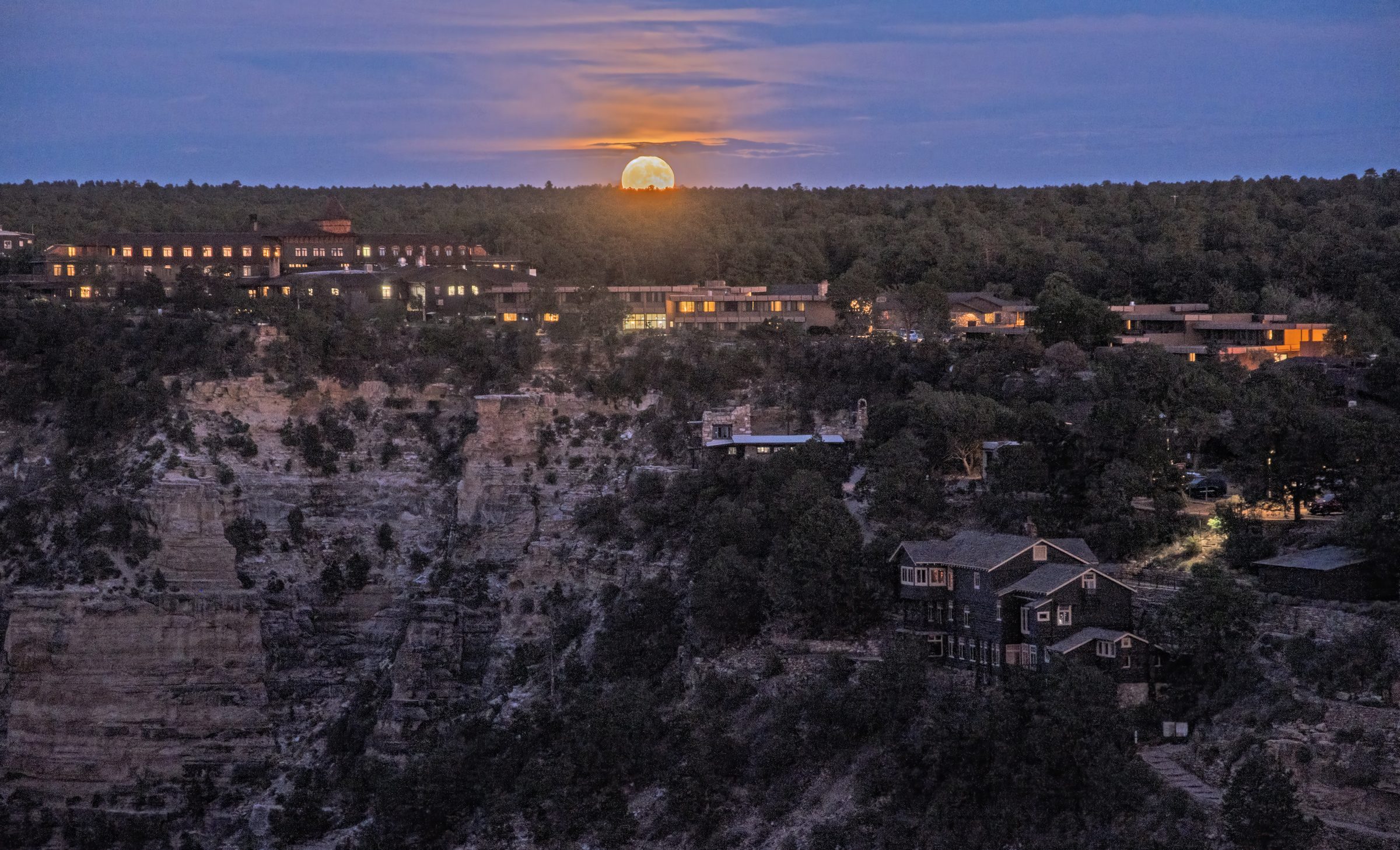
Everyone has seen it. A full Moon climbs over the rooftops or the treeline, huge and orange, and it looks close enough to touch. An hour later, the same Moon is high in the sky — and it has shrunk to a small white disc, no bigger than a coin held at arm's length.
It feels impossible that both Moons are the same object. But they are, and the measurements prove it. The Moon on the horizon is not larger than the Moon overhead. It is, by a small but measurable amount, smaller. What changes is not the Moon at all. It is you.
The first surprise: it is smaller, not bigger
The geometry is simple, and it runs in the opposite direction from what your eyes report. When the Moon is straight overhead, you are standing on the part of Earth that faces it, so you are one Earth radius — 6,378 kilometres — closer to it than Earth's centre is. When the Moon is on your horizon, your line of sight to it runs at right angles to the line from Earth's centre to you, so you are no closer to the Moon than the centre of the Earth is.
The result is that the horizon Moon is about 1.5 percent narrower than the Moon overhead, according to measurements cited by Wikipedia, or about 1.7 percent narrower by the calculation in The Science 360. Either way, the Moon at the horizon is the smaller one — by a margin your eyes could never detect, and in the opposite direction from what they insist they see.
There is a simple way to prove it to yourself. Hold a small pebble — about 8.4 millimetres wide, a third of an inch — at arm's length, about 64 centimetres from your eye, with one eye closed, and position it so that it just covers the full Moon when the Moon is high in the sky. Then wait for a night when the Moon is rising huge on the horizon, and hold the same pebble up again. It will still cover the Moon exactly. Nothing about the Moon's size has changed. Only your impression of it has.
The Moon's apparent size does genuinely vary from month to month, but that is a different effect. The Moon's orbit is not a perfect circle, so its angular diameter ranges from 29.43 arcminutes at apogee, its farthest point, to 33.5 arcminutes at perigee, its closest — a variation of about 14 percent in diameter, or 30 percent in area. That is the difference between a supermoon and a micromoon. But it changes over weeks, not over the hour it takes the Moon to climb from the horizon to overhead.
The atmosphere is not a magnifying glass
The oldest and most popular explanation for the illusion is that Earth's atmosphere acts like a lens and magnifies the Moon near the horizon. It is wrong — and the real effect of the air runs the other way.
The atmosphere does bend moonlight near the horizon. That bending, called refraction, lifts the Moon's lower edge more than its upper edge, because the effect weakens quickly with height. The result is that the rising Moon is squashed, not stretched: about 16 percent shorter than it is wide, slightly oval. Its width is untouched; its height shrinks. Every optical effect the atmosphere has on the Moon near the horizon makes it smaller, not bigger.
What the air does change is the Moon's colour. Near the horizon, moonlight passes through far more air than it does overhead, and the air scatters the shorter blue wavelengths away — the same Rayleigh scattering that makes the daytime sky blue. What is left is the longer red and orange light, which is why a rising Moon looks golden or blood-red. (Read more: Why Is the Sky Blue? The Simple Science Behind the Colour of Daylight) The colour is real. The size is not.
A very old puzzle
People have been noticing this illusion for as long as they have been writing about the sky. It appears in cuneiform on a clay tablet from the Assyrian city of Nineveh, dated to the seventh century BCE. In the fourth century BCE, the Greek philosopher Aristotle wrote about it, attributing it to the effects of mist — an explanation that fails, because the illusion appears in perfectly clear weather too.
Ptolemy tried to explain it twice, around 150 AD, and got no further. The Arab scientist Ibn al-Haytham, writing a thousand years ago, proposed the idea that still leads the field today: that the brain judges the horizon to be farther away than the sky overhead, and so concludes that an object which looks the same size at a greater distance must be physically larger.
The puzzle has survived every century of science since. In their 2002 book The Mystery of the Moon Illusion, psychologists Helen Ross and Cornelis Plug reviewed the whole history of explanations and concluded that "no single theory has emerged victorious." A 2013 book, The Moon Illusion, edited by Maurice Hershenson, gathered 19 chapters by different illusion researchers — and they reached different conclusions. The Moon is the closest thing in the sky, and its most familiar trick is still unsolved.
What your brain might be doing
Scientists agree on one thing: the enlargement happens in the brain, not in the sky. What they disagree on is which part of the brain's size calculation goes wrong. Here are the leading contenders.
The Ponzo illusion. This is the most popular explanation. Draw two horizontal lines of equal length between two lines that converge, like railway tracks running into the distance, and the upper line looks longer — even though you can measure that it is not. Your brain interprets the converging lines as depth, assumes the upper line is farther away, and concludes that something which looks the same size at a greater distance must be physically bigger. The horizon Moon, sitting at the far end of a landscape full of converging lines and receding ground, may be judged the same way. Experiments in the 1950s and 1960s by cognitive psychologists Irvin Rock and Lloyd Kaufman found that people perceive the horizon Moon as much larger than the overhead Moon — sometimes as much as three times bigger.
The apparent distance theory. Ibn al-Haytham's idea, refined by modern research: the brain perceives the sky not as a dome but as a flattened dome, like an upside-down bowl. The horizon feels farther away than the zenith directly above you. If the Moon looks the same angular size in both places, the brain reasons that the one at the greater distance must be larger. The terrain between you and the horizon — trees, buildings, hills — reinforces the sense of distance. But the illusion still occurs over a flat sea or an empty plain, so terrain alone cannot be the whole answer.
Size contrast. A related idea, similar to the Ebbinghaus illusion: a circle surrounded by small circles looks larger than the same circle surrounded by large circles. On the horizon, the Moon sits beside trees and houses, objects your brain knows the size of; overhead, it hangs in an empty sky with nothing to compare it to. The comparison may inflate it. Yet the illusion also persists when the horizon is empty, which weakens this explanation too.
Ross and Plug estimate the typical illusion as an apparent increase in diameter of about 50 percent, and it varies a great deal between people and between nights. Most researchers now suspect that more than one of these effects is at work at once — which may be why no single theory has ever won.
Try it yourself
You do not need equipment to catch your brain in the act. The next full Moon is your laboratory.
First, look at the rising Moon through a rolled-up tube of paper, or through your cupped hands, so that the landscape disappears. With the horizon hidden, the Moon shrinks back toward its true size. Second, take a photograph. A camera records the Moon's true angular size, and in the photo the giant of the horizon is a small disc again — which is why photographs of a "huge" Moon so often disappoint. Third, hold your thumb up at arm's length when the Moon is rising, and again when it is high. Your thumb will cover it both times.
There is one more test, and it is the strangest: bend over and look at the rising Moon between your legs. With your head upside down, the usual cues your brain uses to judge distance are scrambled, and the illusion weakens. It looks silly. It works.
Why it still matters
The Moon illusion is not a curiosity for textbooks. It is a reminder of something easy to forget: that what you see is not the world, but your brain's best guess about the world — and the guess can be wrong by half, in broad daylight, about the nearest object in the sky.
The Moon is drifting away from Earth, a few centimetres a year, and one day it will be too far away for total solar eclipses — a slow farewell measured in hundreds of millions of years. (Read more: The Moon Is Drifting Away From Earth — And One Day the Eclipses Will End) But the illusion needs no telescope and no spacecraft. It needs only a clear evening, a rising Moon, and a willingness to notice that your own eyes are lying to you — beautifully, and for reasons the best minds in science still cannot fully explain. The farthest human-made object is now sailing through interstellar space, yet the nearest object in the sky still keeps a secret. (Read more: Voyager 1: The Farthest Human-Made Object, Still Calling Home From Interstellar Space)
So the next time the Moon rises enormous over the rooftops, enjoy it. It is not really bigger. It is your brain, doing what it has done for every human who ever looked up — and getting it gloriously wrong.



Comments (0)
Comments are reviewed before they appear on the site. Your email address is never shown publicly.
No comments yet — be the first to share your thoughts.