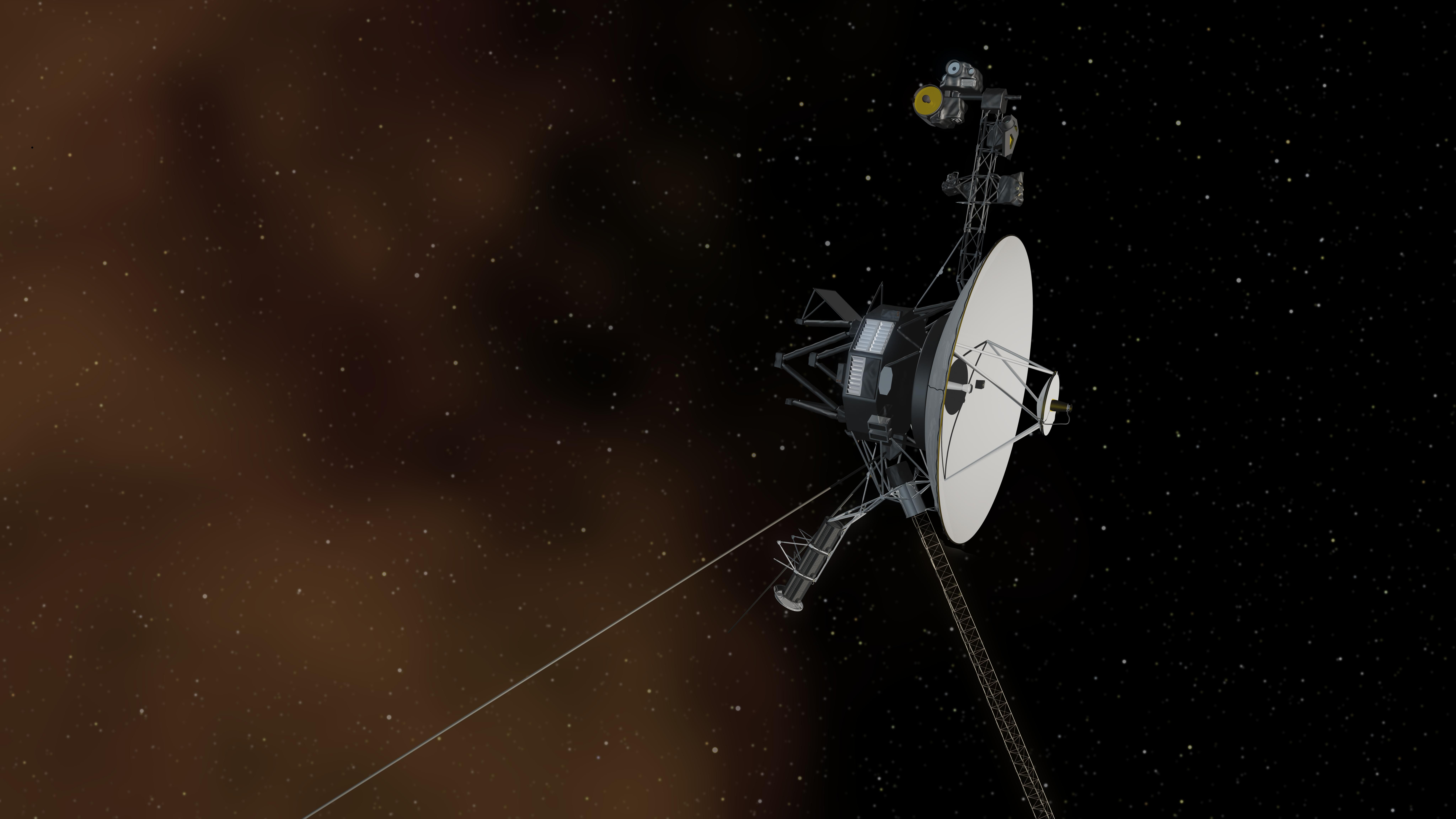
Early on Wednesday 18 November 2026, a spacecraft the size of a small bus crossed a line no human-made object had ever crossed. At 2:16 a.m. Pacific time, Voyager 1 was 16.09 billion miles — 25.9 billion kilometres — from Earth: the distance light travels in exactly 24 hours, one light-day. From that moment on, a radio signal sent to Voyager 1 takes a full day to arrive, and its reply takes another full day to come home.
Voyager 1 has been flying for 49 years. It was built to last five. It has photographed erupting volcanoes on a distant moon, taken the most humbling picture of Earth ever made, and left the Sun's protective bubble altogether. Now it is sailing through the space between the stars, running on a fading nuclear battery, with only two of its ten scientific instruments still switched on.
A light-day from home
To understand how far Voyager 1 has come, start with the light-day. Light moves at about 300,000 kilometres per second, so in one day it covers roughly 25.9 billion kilometres. Voyager 1 reached that distance from Earth on 18 November 2026, according to NASA — the first human-made object ever to do so. It is now about 173 times as far from Earth as the Earth is from the Sun. The Sun itself is eight light-minutes away; Voyager 1 is a full light-day away.
It is still moving fast: about 38,000 miles per hour, or 17 kilometres per second — the fastest any spacecraft is leaving the Solar System.
Built for five years, flying for 49
Voyager 1 launched on 5 September 1977 from Cape Canaveral in Florida, on a Titan IIIE-Centaur rocket. Its twin, Voyager 2, had actually launched first, on 20 August 1977, but Voyager 1 took a faster, shorter path and overtook its sister on 19 December 1977. The two spacecraft were built for a five-year mission: fly past Jupiter and Saturn, send back pictures and measurements, and then fall silent.
They could do so much because of a rare piece of luck. In the late 1970s, Jupiter, Saturn, Uranus and Neptune lined up in a way that happens only about once every 176 years. A spacecraft could swing past one giant planet and let its gravity fling it onward to the next — a technique called a gravity assist. NASA called the plan the Grand Tour.
Jupiter: volcanoes where none should exist
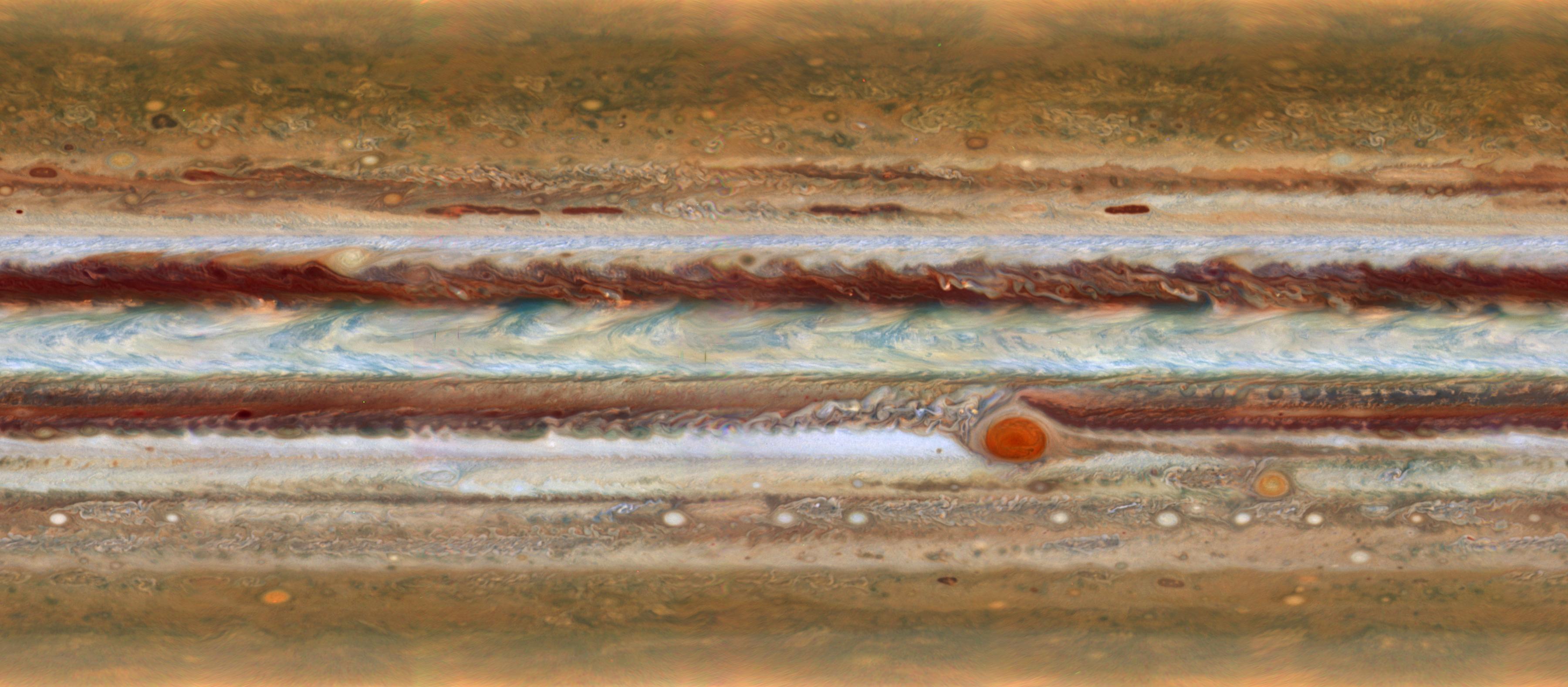
Voyager 1 reached Jupiter in March 1979, making its closest approach — about 217,000 miles above the cloud tops — on 5 March. What it found rewrote the textbooks. On Io, one of Jupiter's moons, it discovered erupting volcanoes: the first active volcanism ever seen anywhere beyond Earth. Io turned out to be the most volcanically active body in the Solar System. Voyager 1 also found a faint ring around Jupiter that nobody knew existed, two new moons, Metis and Thebe, and the first close-up views of Europa, Ganymede and Callisto.
Saturn, Titan, and the end of the tour
Next came Saturn. Voyager 1 made its closest approach, about 77,000 miles above the cloud tops, on 12 November 1980. It mapped the rings, discovering new structure — including a new ring, the G-ring — and five new moons.
Then came the encounter that decided Voyager 1's fate. Mission planners sent it close past Titan, Saturn's largest moon, wrapped in a thick orange haze. Voyager 1 came within about 4,000 miles of its surface and confirmed that Titan has a dense, nitrogen-rich atmosphere — the only moon in the Solar System with one. But the flyby bent Voyager 1's path sharply upward, out of the plane of the planets. There would be no Uranus, no Neptune, no Pluto — but it was now on the fastest track out of the Solar System of any spacecraft ever launched.
The Pale Blue Dot
On 14 February 1990, more than twelve years after launch and about 6 billion kilometres from home, Voyager 1 turned its camera around one last time. At the urging of the astronomer Carl Sagan, it took a series of 60 images — a "family portrait" of the Solar System seen from outside. In one frame, the Earth appears as a tiny speck, less than a single pixel across, caught inside a band of scattered sunlight. Sagan called it the Pale Blue Dot.
His words about that dot are among the most quoted in the history of science: on that speck, he wrote, everyone you have ever loved, everyone you have ever known, everyone who ever lived, lived out their lives — on a mote of dust suspended in a sunbeam. Soon after the portrait was taken, Voyager 1's cameras were switched off for good, to save power. It has taken no photograph since.
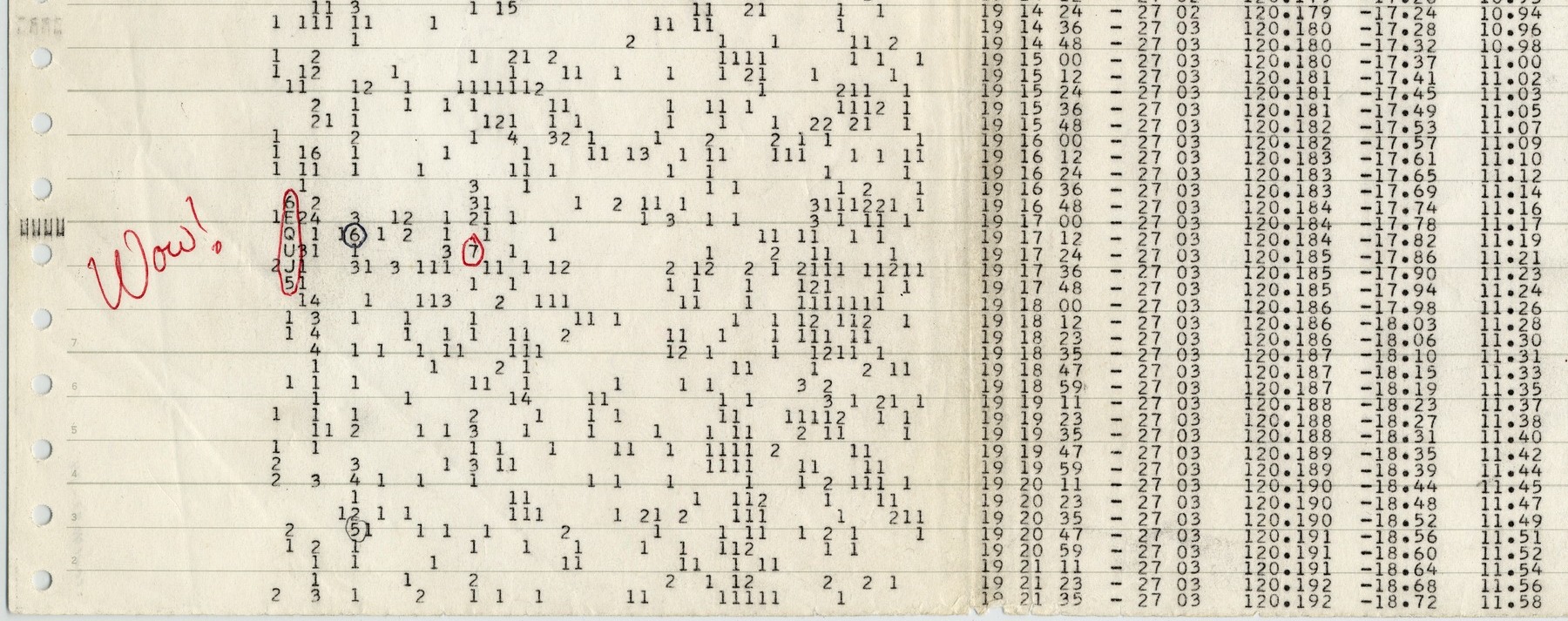
The Pale Blue Dot endures because it is both a measurement — our planet seen from 40.5 times the Earth-Sun distance — and a reminder of scale: everything we care about fits inside less than one pixel. Like the Wow! Signal, heard once and never again, it gave humanity a completely new way of seeing itself.
Leaving the Sun's bubble
After Saturn, Voyager 1 sailed on into the dark. In February 1998 it passed Pioneer 10, becoming the most distant human-made object from Earth — a title it has held ever since. In December 2004, about 94 times the Earth-Sun distance out, it crossed the termination shock, where the solar wind slows abruptly against the pressure of interstellar space.
Then, on 25 August 2012, at about 121 times the Earth-Sun distance, Voyager 1 crossed the heliopause: the boundary where the Sun's wind gives way to the wind between the stars. The charged particles around the spacecraft jumped sharply, particles from the Sun fell away, and galactic cosmic rays surged. NASA announced the crossing in September 2013: Voyager 1 had become the first human-made object to enter interstellar space. Its twin followed in November 2018, and to this day the two Voyagers are the only spacecraft ever to operate outside the heliosphere, the Sun's protective bubble.
How it still talks to Earth
Talking to Voyager 1 is the longest-distance conversation in history. Its radio transmitter puts out only about 20 watts — roughly the power of a refrigerator light bulb — through a dish antenna 3.7 metres across. By the time that whisper has spread across 25.9 billion kilometres, it is less than a billionth of a billionth of a watt when it reaches Earth. Only NASA's Deep Space Network can hear it: giant dishes up to 70 metres across in California, near Madrid and near Canberra, listening around the clock.
The data comes home at a trickle: about 160 bits per second, slower than the dial-up modems of the 1990s. But Voyager 1 no longer takes photographs. It sends numbers — magnetic field readings, particle counts, plasma measurements — and those numbers are enough.
The conversation is fragile. In October 2026, NASA briefly lost contact with Voyager 1 for two days, on 18 and 19 October, before the signal reappeared on its own. One set of thrusters had switched itself off and its backups had taken over, exactly as designed. "This is the first time we've seen the spacecraft do something like this," said Kareem Badaruddin, the mission manager at NASA's Jet Propulsion Laboratory, "but we are also at a point in the mission where we have to expect the unexpected."
Running out of power, one switch at a time
Voyager 1 cannot use sunlight. At its distance, the Sun is just a bright star, far too dim for solar panels. Instead it carries three radioisotope thermoelectric generators — RTGs — which turn the heat of decaying plutonium-238 into electricity. At launch, those generators produced about 470 watts. They lose about 4 watts a year, and after 49 years produce less than half what they did at launch. Nothing can top them up.
So NASA has spent decades switching things off, one by one. Voyager 1 launched with ten scientific instruments. Its cameras went dark in 1990. The cosmic ray subsystem went in February 2025, the low-energy charged particle instrument in April 2026. Only two instruments are still working: the magnetometer, which measures magnetic fields, and the plasma wave subsystem, which listens to the electrically charged gas around the spacecraft.
In September 2026, engineers carried out their most delicate power-saving operation yet. Nicknamed the "Big Bang", it switched off three heaters at once and substituted three lower-power alternatives. The swap had to happen all at once, so power use fell without leaving any part of the spacecraft too cold to work. Without it, NASA said, another science instrument might have had to be switched off as early as summer 2027.
Even so, the end is in sight. By about 2036, Scientific American reports, the generators will no longer produce enough electricity for Voyager 1 to talk to Earth at all. But the spacecraft itself will not stop. With nothing to slow it down, it will keep sailing on through the galaxy, in orbit around the Milky Way, long after its voice has faded.
The Golden Record
Bolted to Voyager 1's side is the Golden Record: a 12-inch gold-plated copper phonograph disc, put together by a committee chaired by Carl Sagan, holding a message from Earth to whoever might one day find it. It carries greetings in 55 languages, sounds of a living world — wind, rain, birdsong, a human heartbeat — music from Bach to Chuck Berry, and 115 images of life on Earth. Its cover explains how to play it and includes a pulsar map pointing back to the Sun.
The chances of anyone ever finding it are vanishingly small. Voyager 1 is heading toward a star called Gliese 445, about 17 light-years away, and will pass within about 1.6 light-years of it — in about 40,000 years. But the record was never really about the odds. It was about the impulse: a species which had just learned to leave its own planet introducing itself to the universe.
Why it still matters
Voyager 1 matters for two reasons, and they are very different. The first is scientific: it is the only instrument humanity has ever placed in interstellar space. Every measurement it sends back is the first of its kind. Telescopes can look; only Voyager can touch.
The second reason is harder to measure, and it is the one that keeps people looking up. Voyager 1 was built by people who knew they would never see most of what it found. Its engineers designed a five-year mission. Their machine is still working 49 years later, a light-day from home.
One day, probably in the 2030s, the signal will stop. The Deep Space Network will listen, and hear nothing. Voyager 1 will go on without us, carrying its golden record toward a star it will not reach for 40,000 years. Until that day, it is still out there — the farthest thing we have ever made, still answering, one day at a time. And while it drifts ever farther from the Sun, the Moon is drifting away from the Earth too — nothing in space ever truly stands still.



Comments (0)
Comments are reviewed before they appear on the site. Your email address is never shown publicly.
No comments yet — be the first to share your thoughts.