Ireland has a missing first chapter. For most of the last century, the oldest accepted evidence of people on the island was a Mesolithic hunter-gatherer camp at Mount Sandel in County Derry, about 10,000 years old. Then, in 2016, a bear bone found in a cardboard box pushed the date back to 12,500 years. Now a new study, published on 26 November 2026 in the Proceedings of the Royal Irish Academy, suggests people may have been there a thousand years earlier still — hunting giant deer in a cold, open landscape at the edge of a warming world.
The evidence comes from Ballynamintra Cave, near Dungarvan in County Waterford, and from bones that were dug out of the cave in the 1870s and 1880s and have sat in the National Museum of Ireland ever since. It is a story about what old museum collections can still tell us — and about the difference between a strong hint and proof.
The bones that may rewrite the date
The study, led by Dr Richard Jennings of Liverpool John Moores University, combined new excavations at Ballynamintra Cave with a modern scientific re-examination of animal bones originally dug from the cave between 1878 and 1882. Re-examining that 19th-century collection, the researchers identified two leg bones from an extinct giant deer, Megaloceros giganteus — the Irish elk — bearing marks consistent with human butchery while the bones were still fresh.
The first is an upper foreleg bone. It shows a uniform chopping plane consistent with a heavy-bladed stone tool used to hack the elbow joint apart, alongside gnaw marks from a wolf that apparently scavenged the carcass afterwards. The second is a lower hindleg bone, showing a possible stone-tool percussion impact and microfractures caused by splitting the fresh bone open to extract the nutrient-rich marrow inside.
High-precision radiocarbon dating at the University of Oxford dated the lower hindleg bone to between 13,573 and 13,321 years ago. That is the number that matters: if the marks are human, people were in southern Ireland around 13,500 years ago — nearly a millennium before the earliest currently confirmed evidence.
The team's new excavations support the picture. Working in an intact section of cave sediment that Victorian antiquarians never disturbed, they recovered previously untouched Ice Age layers containing three giant deer specimens and a red fox jawbone radiocarbon dated to between 13,604 and 13,095 years ago, alongside preserved ancient pollen indicating an open grassland landscape fringed by ferns, juniper and birch. It was a cold, open world — and the deer were in it.
Why 13,500 years ago makes sense — and why it is not proven
The timing fits what is known about the wider region. The bones date to a warm interval near the end of the last Ice Age known as the Middle Allerød, when hunter-gatherers were active across Britain and north-west Europe. Britain itself was recolonised by humans from around 15,000 years ago, after the ice retreated. Ireland, separated from Britain by rising seas, was always going to be reached later — the question was how much later.
But the researchers are careful about what they have — and have not — shown. Because surface weathering over millennia erased the microscopic tool striations on the bones, the marks cannot yet be proven as definitively human-made without additional artefacts. No stone tools were found with the bones. A chop mark and a percussion fracture are consistent with butchery, but nature and scavengers can produce marks that look similar, and only the fine scratches a stone edge leaves behind would settle it.
"Confirming human activity at Ballynamintra Cave 13,500 years ago would significantly push back the arrival of people in Ireland and reshape how we understand early human dispersal across northwest Europe at the end of the last Ice Age," said Dr Jennings. The word doing the work there is "confirming". The study offers the strongest hint yet; confirmation will need more evidence from the cave or from other Irish sites.
The bear bone that set the current record
To understand why 13,500 years would be such a shift, it helps to know how the current record was set — because it was set in almost exactly the same way.
In 2010 and 2011, animal bone specialist Ruth Carden of the National Museum of Ireland was re-analysing bones collected from cave excavations in the early 20th century when she came across part of a knee from a brown bear, covered in cut marks. The bone had been dug from Alice and Gwendoline Cave outside Ennis in County Clare in 1903, noted in the original excavation report, and then stored away with thousands of other remains in cardboard boxes for a century.
Carden brought the bone to Marion Dowd, a cave archaeology specialist. Samples went to Queen's University Belfast and then to Oxford University, and both laboratories agreed: the bear had been butchered 12,500 years ago — 2,500 years before the earliest previous evidence. Three specialists confirmed the seven cut marks were made on fresh bone, probably by someone inexperienced using a long flint blade, cutting through the tough knee joint, perhaps to extract the tendons for string or sewing. The results were published in Quaternary Science Reviews in 2016.
Before that find, the human history of Ireland stretched back only to Mount Sandel, the 10,000-year-old camp on the River Bann. The bear bone rewrote the first chapter by two and a half millennia — and it did so from a museum box, not a new dig. Carden, notably, is also part of the team behind the new Ballynamintra work, through a University College Dublin project re-examining Ireland's cave bone archives for signs of the island's first people.
The giant deer: a lost giant of the Ice Age
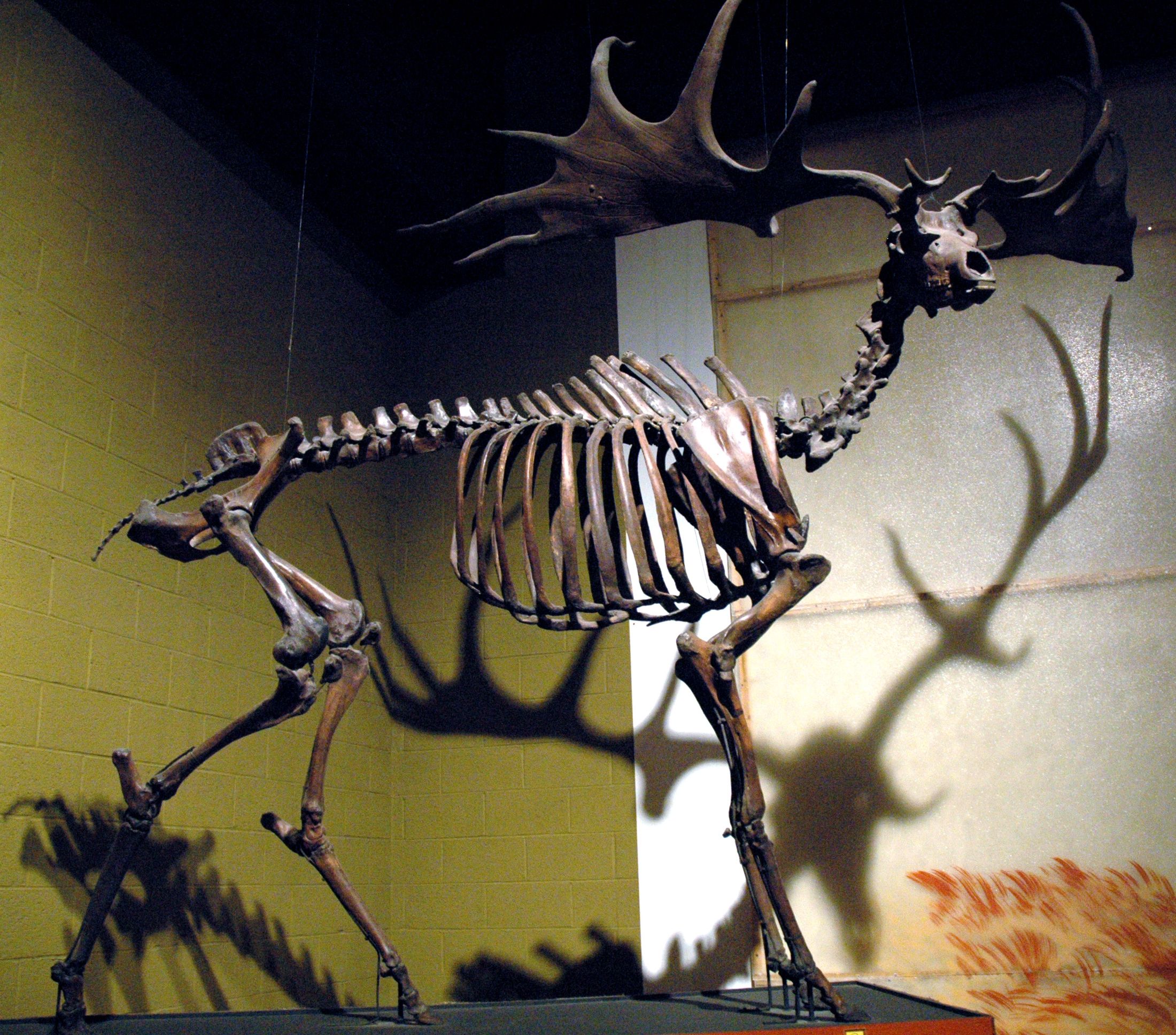
The animal at the centre of the new study is worth meeting on its own. Megaloceros giganteus, the giant deer or Irish elk, was one of the largest deer that ever lived, standing around two metres tall at the shoulder. The males carried antlers spanning up to 3.5 metres — the largest antlers of any known deer — which makes the skeleton, mounted in museums around the world, one of the most spectacular Ice Age animals ever found.
Despite the name, it was neither exclusively Irish nor an elk. Its remains are found across Europe and into Asia, and Ireland's peat bogs preserved so many of them that the animal became associated with the island. The giant deer survived the end of the Ice Age but died out around 7,700 years ago, one of the last of the great Ice Age mammals to disappear.
For a hunter-gatherer in 13,500-year-old Ireland, a giant deer would have been an enormous prize: hundreds of kilograms of meat, marrow-rich bones, hide and antler. The marrow in the lower hindleg bone — the bone the researchers dated — was exactly the kind of rich food that made splitting a fresh bone worth the effort.
What would turn a hint into proof
The Ballynamintra study is, in the end, a beginning rather than a verdict. The researchers have two bones with suggestive marks and a firm date, from a cave that has already yielded undisturbed Ice Age layers. What they need next is the kind of evidence that cannot be argued with: a stone tool in the same layer, more bones with the same pattern of marks, or cut marks fresh enough under the microscope to show the signature of a stone edge.
That is why the work matters beyond one cave. Ireland's museums hold thousands of animal bones dug from caves by Victorian antiquarians who had no way to date them and no microscope fine enough to read their surfaces. The 2016 bear bone and the 2026 deer bones both came from those old collections. As dating and microscopy improve, the boxes keep answering questions nobody thought to ask when they were packed away.
"It is very likely that the date of human existence in Ireland will be pushed back even further," Marion Dowd said when the bear bone was announced in 2016. Ten years later, the deer bones of Ballynamintra suggest she was right — and that the first people in Ireland may have arrived a thousand years before we can yet prove. (Read more: Petra: The Lost City Carved Into Rose-Red Rock)
The first chapter of Irish history is still being written, and it is being written from bones that have been waiting in museum drawers for 140 years. The next chapter may already be sitting in a box, waiting for someone to look at it properly. (Read more: Why Does the Moon Look So Big on the Horizon? The 2,000-Year-Old Illusion Science Still Can't Fully Explain)




Comments (0)
Comments are reviewed before they appear on the site. Your email address is never shown publicly.
No comments yet — be the first to share your thoughts.