Imagine a world where every book you have ever read had to be copied out by hand, letter by letter, by someone sitting at a desk for months. A single Bible could take a scribe more than a year to finish. Books were so rare and so expensive that only churches, universities and the very rich owned more than a handful. Then, in the 1450s, a German goldsmith in Mainz found a way to print books by machine — and within a lifetime, the price of knowledge collapsed.
His name was Johannes Gutenberg. He did not invent writing, paper or even printing itself. What he did was combine several existing ideas — movable metal letters, thick oil-based ink and a screw press borrowed from winemakers — into one practical system. That system turned book-making from a slow craft into an industry, and it changed the world more than almost any other invention of the last thousand years.
Before Gutenberg: a world copied by hand
For most of European history, a book existed only because someone had written it out by hand. In monasteries, monks worked in rooms called scriptoria, copying religious texts, classical works and legal documents onto parchment — specially prepared animal skin — or, increasingly, onto paper. A good copyist could manage only a few pages a day, and a long book like the Bible took a year or more. Some finely decorated copies took two or three years.
There was one earlier shortcut. In Europe, printers carved a whole page of text into a wooden block, inked it and pressed paper onto it. These “block books” were cheap to reproduce once the block was carved — but carving a single page took days, and carving the blocks for an entire Bible would have taken decades. Block printing worked for short texts and pictures. It could never produce a library.
Printing already existed — just not like this
Gutenberg was not the first person in history to think of movable type. In China, the artisan Bi Sheng had made reusable type from baked clay around 1040, some four centuries earlier. Later, printers in Korea cast type in metal: the oldest surviving book printed with movable metal type, the Jikji, was printed in Korea in 1377. In China, woodblock printing was already old — the Diamond Sutra, printed in 868, is the earliest dated printed book in the world.
But these systems never spread far beyond East Asia, partly because Chinese writing uses thousands of characters, which made movable type hard to organise. European alphabets, by contrast, need only a few dozen letters. Gutenberg may never have heard of the Chinese and Korean experiments — historians still debate whether the idea reached Europe along trade routes or whether he arrived at it on his own. What is certain is that he was the first to make movable type work as a complete, commercial system in Europe.
What Gutenberg actually invented
Gutenberg was a goldsmith by training, and that mattered. He understood metal, and he understood precision. His system had four parts, and each one solved a problem that had stopped earlier printers.
- Movable metal type. Gutenberg cast individual letters from an alloy of lead, tin and antimony — a mixture that melted easily, cooled quickly and stayed hard enough to survive thousands of impressions. Each letter was identical, and the letters could be arranged into words, locked into a frame, printed, and then taken apart and reused for the next page. That alloy remained the standard material for printing type for about 550 years.
- A hand mould. To cast those letters quickly and exactly the same size, Gutenberg devised a mould that could produce type in large numbers. Without it, every letter would have had to be made by hand, and the whole idea would have been too slow to be worth doing.
- Oil-based ink. The water-based inks used by scribes would not stick to metal type. Gutenberg developed a thick, sticky, oil-based ink that coated the metal evenly and transferred cleanly onto paper or vellum.
- The screw press. Gutenberg adapted the heavy screw press already used to squeeze wine, oil and paper. A flat plate, turned down by a long screw, pressed a sheet of paper firmly and evenly onto the inked type. It was simple, strong and fast.
None of these parts was magic on its own. The genius was putting them together so that a small workshop could print page after page, day after day, with every copy the same. By one estimate, a single press could produce up to 3,600 pages in a working day, against roughly 40 pages a day for hand-printing — and only a few pages a day for a scribe copying by hand.
The Gutenberg Bible
Gutenberg proved his system with the most ambitious book he could choose: the Bible. It was the book every church, monastery and university wanted, and it was the hardest test of his machine — a huge text that had to look as beautiful as the finest handwritten copies.
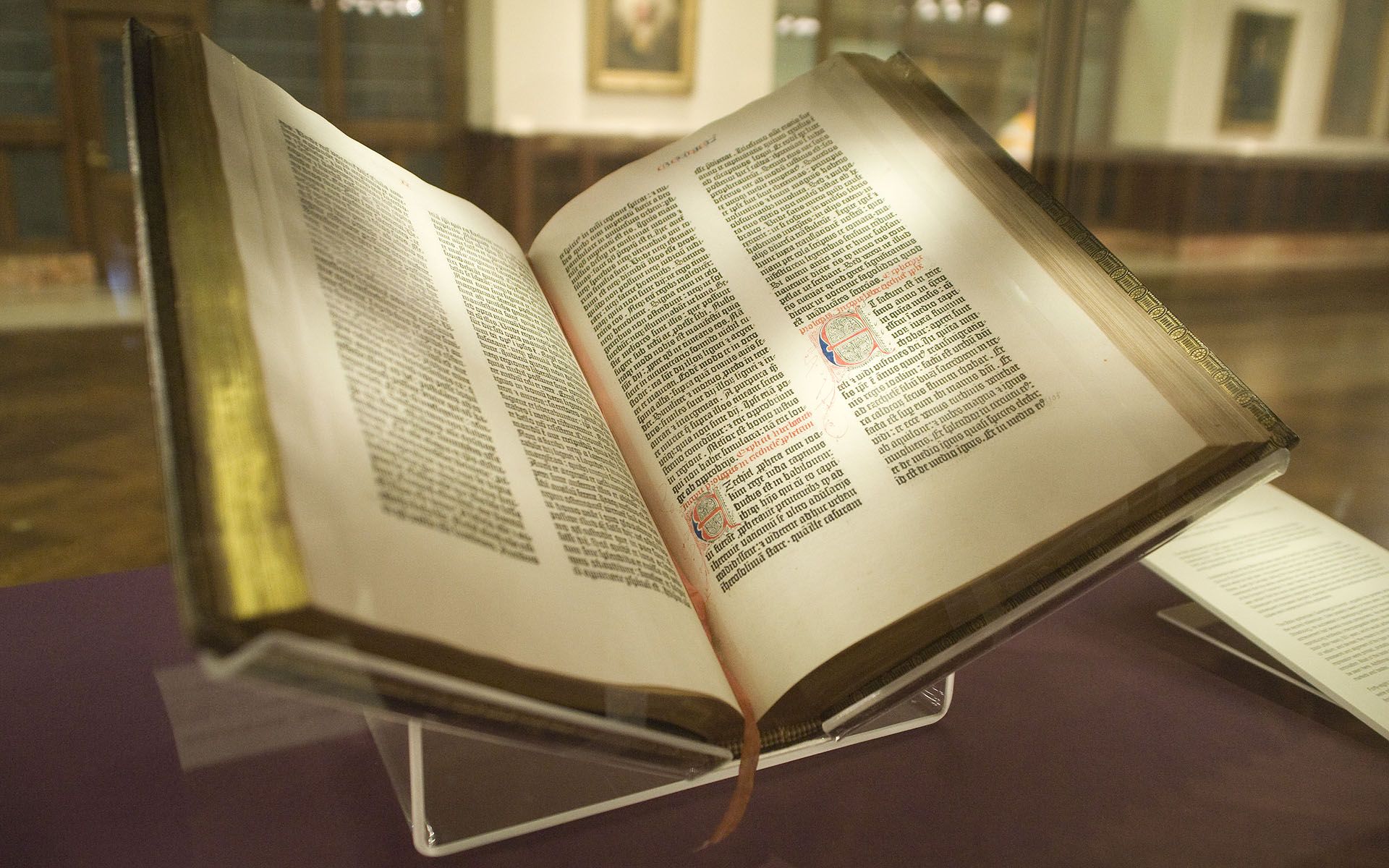
The result is known as the Gutenberg Bible, or the 42-line Bible, because each column of text has 42 lines. It is a Latin translation of the Bible, the Vulgate, printed in two large volumes with nearly 1,300 pages. Gutenberg deliberately made it look like a manuscript: no title page, no page numbers, and spaces left for artists to paint in coloured initials by hand.
Work probably began around 1452, and the Bible was most likely finished between March and November 1455. The exact number printed is not certain — a letter written in March 1455 mentions both 158 and 180 copies, and scholars today think the true figure was somewhere around 180, with about 45 of them printed on vellum (calfskin) and the rest on paper. Of those, 48 copies survive today in whole or in large part, including 11 on vellum. Two complete copies are held by the British Library.
Even at the time, a printed Bible was not cheap. Copies sold for about 30 florins — roughly three years’ wages for an average clerk. But that was still far less than a handwritten Bible, which could cost many times more and take a scribe over a year to produce. And once the type was set, Gutenberg could print copy after copy at little extra cost. That was the real revolution: the first copy was expensive, but the hundredth was cheap.
The man who lost his own workshop
Gutenberg’s triumph did not make him rich. In 1450 he persuaded a wealthy Mainz financier, Johann Fust, to lend him 800 guilders; two years later Fust invested another 800. When the loans came due, Fust sued. In November 1455, the same year the Bible was completed, Gutenberg lost the case and was ordered to repay the loans with interest — probably about 2,020 guilders in total. Fust took over the workshop, the type and the equipment.
Fust went on printing with Gutenberg’s former assistant, Peter Schöffer. Their Mainz Psalter of 1457 was the first printed book in Europe to name its printers. Gutenberg himself kept working — later scholarship suggests he ran another print shop through the 1450s and into the 1460s — but he never regained his first workshop. In January 1465, the Archbishop of Mainz granted him a pension of grain, wine and clothing. He died in Mainz, probably on 3 February 1468. The invention that made millions of books possible had not made its inventor a fortune.
How fast print spread
What Gutenberg lost in Mainz, Europe gained everywhere else. His workers carried the knowledge with them, and within about fifteen years of the Bible, printing presses had been set up across almost all of western Europe. The sack of Mainz in 1462 scattered trained printers along the trade routes, and the spread only accelerated: by 1480, printers were active in about 110 towns across Germany, Italy, France, Spain, the Netherlands, Switzerland, England and beyond.
By 1500 — just 45 years after the Gutenberg Bible — presses were working in more than 200 cities, and they had already produced over 20 million printed volumes. In the 1500s, output rose to an estimated 150 to 200 million copies. Before the press, Europe’s books could be counted in the tens of thousands. Within two generations, they could be counted in the millions.
Books also became cheaper as printers competed. By the 1490s, a printed edition of a major classical work in Venice, then Europe’s leading printing centre, cost roughly a month’s salary for a schoolteacher — still a serious purchase, but within reach of a professional household for the first time.
What the press unlocked
Cheap books changed who could learn, who could argue and who could be heard. Four consequences stand out.
The Reformation. When Martin Luther published his 95 Theses in 1517, challenging the Catholic Church’s sale of indulgences, earlier critics had made similar arguments — and been ignored. Luther had the press. His pamphlets were reprinted in city after city, and an estimated 300,000 copies of his tracts were distributed between 1518 and 1520. Book publishing in Germany rose sevenfold between 1518 and 1524. A local theological dispute became a continent-wide movement that permanently divided Western Christianity.
Science. Before printing, a scholar’s discoveries travelled slowly and unreliably, copied by hand with errors creeping in at every stage. Print let scientists share identical diagrams, tables and texts across the whole of Europe. When Copernicus, Galileo and later Newton published, other scientists could read the same words, check the same figures and build on the same results. The Scientific Revolution depended on that shared, exact record. The scholar Erasmus sold at least 750,000 copies of his works in his lifetime, a scale of readership no earlier author could have imagined.
Newspapers and public debate. Printers soon discovered that short, topical sheets sold well. Printed news bulletins spread through the 1500s, and in 1605 Johann Carolus began publishing the Relation in Strasbourg, a weekly printed newspaper widely accepted as the first of its kind. For the first time, ordinary readers could follow events beyond their own town while those events were still happening.
Literacy and language. As books became cheaper and more common, more people had a reason to learn to read — and more children were taught. Literacy rose steadily across the following centuries. Print also helped local languages grow: Bibles, pamphlets and schoolbooks appeared in German, French, English and other everyday languages, not only in Latin, and the printed word helped standardise spelling and grammar.
Why it still matters
Gutenberg’s press remained the basic technology of printing for about 500 years, until hot-metal typesetting arrived in the 19th century. But its real legacy is not the machine. It is the idea that information can be copied exactly, cheaply and at scale — and that once it can, no authority can fully control it.
Every later information revolution follows the same pattern. The newspaper, the paperback, the photocopier, the internet and the smartphone all did what Gutenberg’s press did: they took the cost of copying down and the number of copies up, and they put knowledge into hands that had never held it before.
Gutenberg did not set out to change the world. He set out to print a beautiful Bible and make a living. The machine he built did the rest.



Comments (0)
Comments are reviewed before they appear on the site. Your email address is never shown publicly.
No comments yet — be the first to share your thoughts.