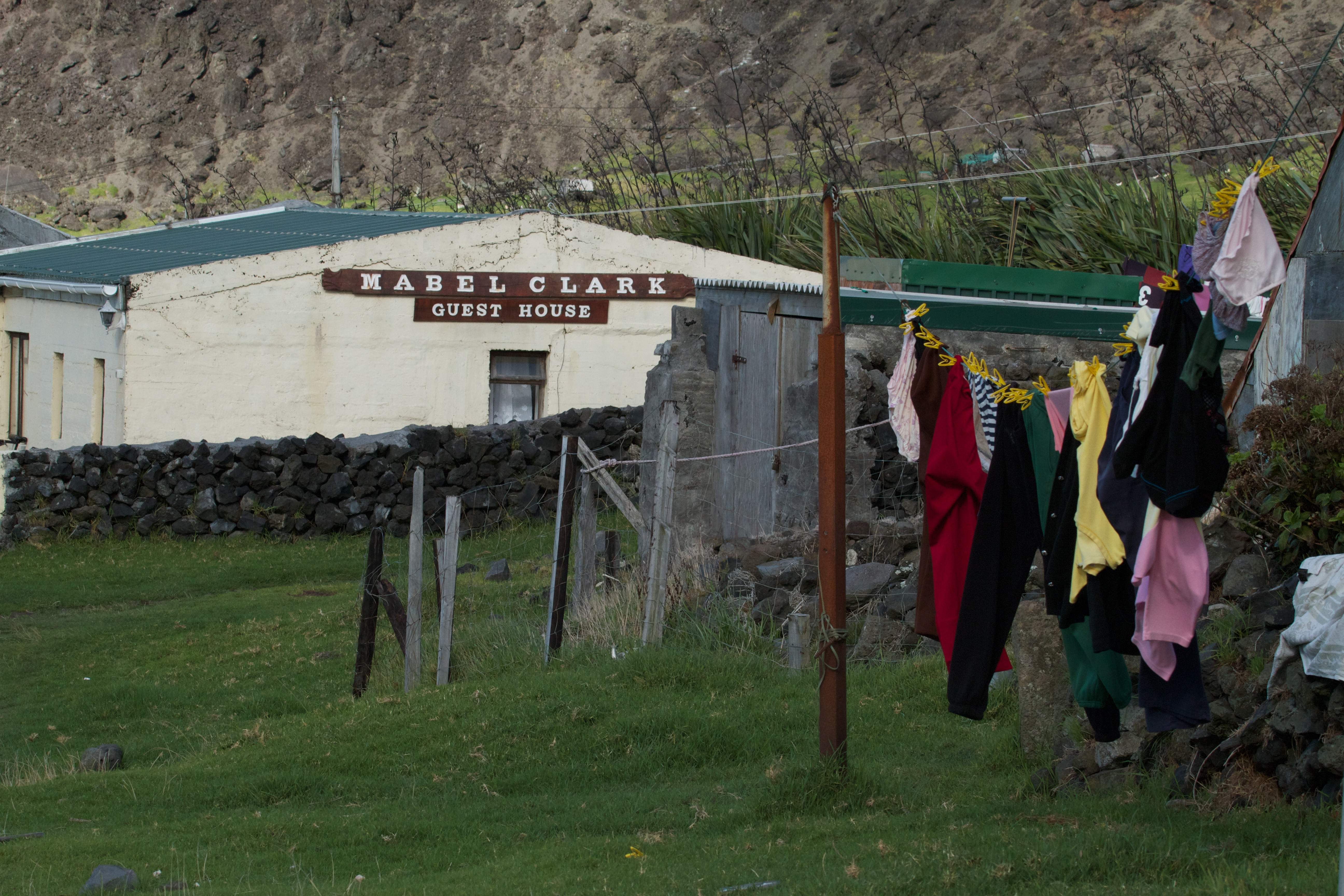
The most remote address on Earth
Tristan da Cunha is a remote group of volcanic islands in the South Atlantic Ocean, part of the British Overseas Territory of Saint Helena, Ascension and Tristan da Cunha. The main island is roughly 11 kilometres across and 98 square kilometres in area, a single volcanic cone rising to Queen Mary's Peak at 2,062 metres. It is the most remote inhabited island in the world, and its only settlement — Edinburgh of the Seven Seas — is regarded as the most remote permanent settlement on Earth.
The numbers give the scale of it. The nearest speck of land outside the archipelago, Saint Helena, is about 2,430 km away. The nearest continent, Africa, is over 2,816 km away. The entire population — about 220 people by the 2026 census, which counted 221, with an official update in September 2026 putting it at 222 permanent inhabitants, all British Overseas Territories citizens — lives on the only flat piece of the island, a patch of ground at the foot of the volcano that the islanders simply call "the Settlement."
And there are only seven unique surnames among them.
How you get there
There is no airstrip on Tristan da Cunha. There never has been. The only way to travel to or from the island is by ship, and the journey from Cape Town, South Africa, takes about six days across open ocean — five to ten days depending on the weather and the vessel. The South African polar research ship SA Agulhas II and the fishing vessels Edinburgh and Lance make the voyage several times a year. A return ticket on Agulhas costs about US$500; on one of the fishing vessels, about US$1,000 for tourists.
Visitors are the lowest priority for passage. Islanders, officials and medical evacuations all rank ahead of them, and a visitor can be bumped from a departing ship if someone with a higher priority needs the berth. Every visitor must apply in advance to the Tristan government and receive permission before booking passage; there are no visas, but there is a landing fee, a police certificate may be requested, and journalists and filmmakers need special permits. There is no mobile phone network on the island, though visitors can connect to a visitors' Starlink network for WhatsApp and email. Post sent from the island's post office will likely travel back with you on the same ship — expect it to take a couple of weeks to arrive.
Once there, walking is the most common way of getting around. There is a single paved road, the M1, running about three miles from Edinburgh to the Potato Patches, where the islanders grow their staple crop. There are no vehicles for hire, though local transport — an islander's car, a tractor, a morning bus for pensioners — can be arranged.
A village with one of everything
Edinburgh of the Seven Seas has one of nearly everything a village needs, and almost nothing more. One supermarket, one post office and tourism centre, one pub — the Albatross Bar, inside Prince Philip Hall, which is most reliably open when cruise ships are docked — two churches (St Mary's Anglican, which also serves as the school, and St Joseph's Catholic), one swimming pool open in the summer, and one golf course, often called the most remote golf course in the world. A golf package, including play, certificate, scorecard and tie, can be arranged for around £20.
The islanders live by fishing and farming, in an economy that is largely self-sufficient. The crawfish — rock lobster — trade is one of the largest economic resources; the catch is processed in the island's fish factory and exported. Sheep roam the fields, wool is a staple, and the land is communally owned, with stock numbers strictly controlled for pasture conservation — and so that no one can accumulate too much wealth. Many adults hold secure, salaried jobs within the local government. No outsiders are allowed to buy land or settle on the island.
The community is close in the literal sense: when a person's home is damaged or in need of repair, everyone on the island chips in. Each year residents gather for "Ratting Day" to hunt invasive rats and protect crops and wildlife. The island is home to rare birds, including the Tristan thrush, the flightless Inaccessible Island rail, and the northern rockhopper penguin. Gough Island, part of the archipelago some 300 km away, is a UNESCO World Heritage Site for its seabird populations.
Five centuries of isolation
The islands were first recorded as sighted in 1506 by Portuguese explorer Tristão da Cunha, who named the main island after himself — Ilha de Tristão da Cunha — though rough seas prevented a landing. The first undisputed landing came in 1643, when the crew of the Dutch East India Company ship Heemstede came ashore for provisions. The Dutch came back, the French surveyed, and the islands sat on the preferred sailing routes from Europe to the Indian Ocean — until the opening of the Suez Canal in 1869 and the move from sail to steam made them, almost overnight, a backwater.
The first permanent settler was Jonathan Lambert of Salem, Massachusetts, who arrived in December 1810 with two other men and declared the islands his property, naming them the "Islands of Refreshment." Three of the four men died within two years. In 1816, the United Kingdom annexed the islands, dispatching a garrison largely to prevent the French from using them as a base to free Napoleon, imprisoned on Saint Helena 2,430 km to the north. When the garrison departed in 1817, a corporal named William Glass stayed with his family, and a small civilian community of mixed backgrounds gradually grew around him. In 1867, Prince Alfred, Duke of Edinburgh, Queen Victoria's second son, visited the islands, and the settlement was renamed Edinburgh of the Seven Seas in his honour.
The island was so isolated during the First World War that its inhabitants were unaware the conflict had even started until they received word in 1919 that it had ended.
The volcano that emptied the island
In 1961, Queen Mary's Peak erupted, and the entire population was evacuated to England, to a site near Southampton. They stayed away for two years. Most returned in 1963, to rebuild on the same flat ground at the foot of the same volcano.
That decision — to go back — says most of what there is to say about the place. The islanders could have stayed in England. They chose the volcano, the six-day boat ride, the one shop, the seven surnames, and the settlement where everyone knows everyone, because it is home. Today the population hovers around 220, and the residents intend to keep it that way.
Tristan da Cunha is often described as the ultimate "how do people actually live there?" story, and the answer is the least exotic part of it: they fish, they farm, they shear sheep, they go to church on Sunday mornings, they play golf on the most remote course on Earth, and they watch the horizon for the next ship. The remoteness is not a hardship they endure. It is the point.

Comments (0)
Comments are reviewed before they appear on the site. Your email address is never shown publicly.
No comments yet — be the first to share your thoughts.