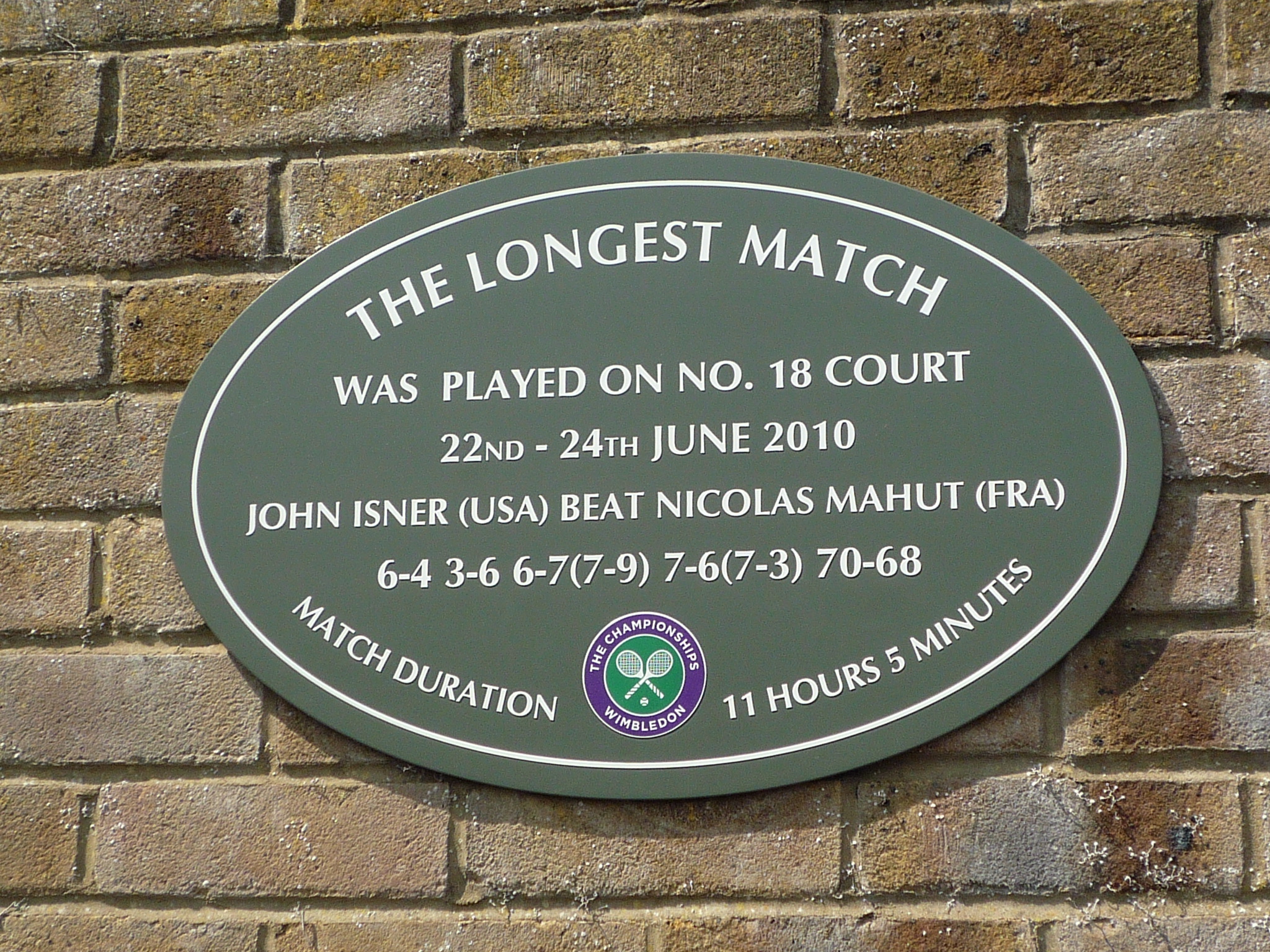
At 6:13 p.m. on Tuesday, 22 June 2010, two men walked onto Court 18 at Wimbledon for a first-round match that nobody expected to remember. One was John Isner, a 6-foot-10 American seeded 23rd. The other was Nicolas Mahut, a French qualifier ranked 148th who had fought through three rounds of qualifying just to reach the main draw.
Three days later, they walked off the same court as the most famous first-round players in the history of tennis. The match had lasted 11 hours and 5 minutes. The final set alone — 70 games to 68 — had taken 8 hours and 11 minutes, longer than any complete tennis match ever played before it. A total of 183 games were played, and 216 aces were served. The scoreboard had given up. And when it was finally over, the winner could barely stand — then lost his next match in straight sets, without serving a single ace.
An Ordinary Tuesday
Nothing about the start of the match suggested history. Court 18 is one of Wimbledon's larger outside courts, but it is not Centre Court, and a first-round match between the 23rd seed and a qualifier is the kind of fixture that usually passes without notice. The first four sets played out like a normal, if hard-fought, grass-court match.
Isner took the first set 6–4, breaking Mahut's serve in the ninth game after the Frenchman double-faulted twice. Mahut answered by taking the second set 6–3. The third and fourth sets produced no breaks of serve at all and were both decided by tiebreaks: Mahut won the third 9–7, Isner the fourth 7–3. Two sets each. Four sets played, two hours and 54 minutes on the clock, and fading light stopped play for the night.
Nobody on court that evening knew what the next day would bring. Nobody in the crowd did either. But by the following afternoon, word had begun to spread through the grounds and then around the world: the two men on Court 18 simply could not break each other's serve.
The Set That Would Not End
Under the rules in force in 2010, there was no tiebreak in the fifth set at Wimbledon. A player had to win by two games, however long that took. On grass, against two of the biggest servers in the sport, that turned out to be a very long time indeed. The fifth set began on Wednesday, 23 June, and the two men held serve 168 times in a row — 84 each — with only three breaks of serve in the whole match.
The numbers piled up faster than anyone could process them. At 32–32 in the fifth set, after 6 hours and 34 minutes of total play, Isner and Mahut officially passed the previous record for the longest match in tennis history: 6 hours and 33 minutes, set by Fabrice Santoro and Arnaud Clément in the first round of the 2004 French Open. The crowd cheered. The players kept playing. They had barely started.
Isner had chances to end it. He failed to convert four match points that Wednesday: one when Mahut was serving at 9–10, two more at 32–33, and a fourth at 58–59. Mahut had his own chances — two break points at 50–50, both saved. Each time, the man serving found one more huge serve, one more way to survive.
By then the match had become a global event. People in offices, bars and homes across the United States began watching a tennis match they had never planned to watch. Journalists crowded around Court 18. Players finished their own matches and came to watch. The score crept upward in disbelief: 20–all, 30–all, 40–all, 50–all.
And then, at 47–47, the scoreboard gave up. It had been programmed to go only that far, and it froze, then went dark altogether. The online scoreboard lasted a little longer before it too had to be reset at 50–50. An IBM programmer worked on a fix until 11:45 p.m. that night so the system could cope with the numbers the next day.
At 9:09 p.m., with the score at 59–59 in the fifth set and darkness falling over south-west London, play was suspended for the second time. The two men had played 7 hours and 4 minutes that day alone. They went to bed not knowing when — or how — it would end.
Thursday: 70–68
They returned on Thursday, 24 June, at 3:40 p.m., to a court surrounded by a crowd that had grown far beyond anything Court 18 was built for. The world was watching now. And still, neither man could break serve.
Mahut served to stay in the match 63 times over the course of the final set. At 68–68, he even reached 0–30 on Isner's serve — the closest he ever came to breaking the American in the decider — before Isner fought back to hold.
Then, at 69–68, the moment finally came. Isner earned his fifth match point with a forehand pass. One point later, he threaded a backhand passing shot down the line, and it was over. At 4:47 p.m., after 67 minutes of play on the third day, John Isner had won the deciding set 70–68. The final score read 6–4, 3–6, 6–7(7–9), 7–6(7–3), 70–68. The total playing time was 11 hours and 5 minutes, spread over three days.
The two men stayed on court for a ceremony. Tim Henman and Ann Haydon-Jones, on behalf of the All England Club, presented both players and the chair umpire, Mohamed Lahyani, with a crystal bowl and champagne flutes. Mahut later donated memorabilia from the match to the International Tennis Hall of Fame museum in Newport, Rhode Island, and the All England Club placed a plaque on Court 18 commemorating the match. It is still there today.
The Records, All at Once
The match set at least eleven tennis records, and the list reads like a misprint:
- Longest match: 11 hours, 5 minutes.
- Longest set: the fifth set alone took 8 hours and 11 minutes — longer than the previous longest match, and longer than the longest professional baseball game ever played (8 hours and 6 minutes).
- Most games in a match: 183. The previous record was 112, set by Pancho Gonzales against Charlie Pasarell at Wimbledon in 1969.
- Most games in a set: 138 in the fifth set.
- Most aces: 216 in total — 113 by Isner and 103 by Mahut. The previous single-match record was 78, held by Ivo Karlović. (Early reports during the match put Isner's total at 112; the official corrected count is 113.)
- Most points won by one player: Mahut won 502 points — a record for a losing player, and for any player in a single match.
- Most consecutive service games held: 168, with 84 each.
Consider what those numbers mean in human terms. The fifth set alone contained more games than most complete matches. Mahut, the loser, won more points than the winner. And the two men served a combined 216 aces — more than two and a half times the old record — because for hour after hour, holding serve was the only thing either of them could reliably do.
The Morning After
If the match itself was extraordinary, what happened next was almost cruel. Isner had roughly a day to recover before his second-round match against Thiemo de Bakker of the Netherlands. He lost 0–6, 3–6, 2–6. He did not serve a single ace — the only match of his entire career in which that happened. He also withdrew from the doubles, where he had been seeded 12th with Sam Querrey.
Mahut, meanwhile, went straight back out onto Court 18 that same Thursday evening to play doubles — and had to leave the court because of darkness for the third evening in a row.
Both men were rewarded for their ordeal. They jointly won the 2010 ESPY Award for Best Record-Breaking Performance in sport. Mahut later wrote a book about the experience, titled The Match of My Life. And the two players, who had barely known each other before that week, became good friends — a friendship that has lasted ever since.
The Rematch
Fate, which had already given tennis one of its great stories, decided to repeat the joke. In 2011, the Wimbledon draw paired Isner and Mahut against each other in the first round again.
This time, mercifully, it was a normal match. Played on the newly built Court 3 rather than Court 18 — Isner joked that he was glad, because he did not know if the club wanted "to tarnish the legacy of Court 18 by playing a second time" — Isner won in straight sets, 7–6(4), 6–2, 7–6(6), in 2 hours and 3 minutes. Each man served eight aces.
Why It Can Never Happen Again
The Isner–Mahut match did more than set records. It changed the rules of tennis.
Isner himself was at the centre of the next marathon. In the 2018 Wimbledon semi-final, he lost to Kevin Anderson 7–6, 6–7, 6–7, 6–4, 26–24 in 6 hours and 36 minutes — the second-longest match at a Grand Slam. That was enough for Wimbledon. In 2019, the tournament introduced a tiebreak at 12–12 in the final set. Then in 2022, all four Grand Slam tournaments agreed on a single rule: at 6–6 in the deciding set, the players contest a first-to-10-points tiebreak.
A deciding set can still be long, and a tiebreak can still stretch on. But no final set can ever reach 70–68 again. The format that made Isner–Mahut possible no longer exists. Wimbledon itself has called the record one that will probably never be broken.
What Became of Them
Neither man faded away after Court 18. Isner went on to the best years of his career. He reached a career-high ranking of world No. 8 in July 2018, after winning the Miami Open — his first Masters 1000 title, aged 32 — and reaching his first Grand Slam semi-final at Wimbledon that same summer. He won 16 singles titles, finished inside the world's top 20 for ten consecutive years, and set the all-time record for career aces, with 14,411 according to the ATP. He retired after the 2023 US Open as one of the greatest servers the sport has ever seen.
Mahut went on to a long and successful doubles career, and to a friendship with Isner that outlasted both of their playing days. He has said many times since that he is proud of the match, even though he lost it — and who could blame him? Losing players are forgotten every day. Mahut is remembered forever.
That is the strange truth of the longest match in tennis history. It was a first-round match, played on an outside court, between a seeded American and a French qualifier almost nobody had heard of. It had no trophy at the end of it. The winner lost his next match 6–0, 6–3, 6–2. And yet, fifteen years later, it is still the first thing most people think of when they hear either man's name. It lasted 11 hours and 5 minutes, took 183 games, and ended 70–68 — and tennis made sure it will never happen again, which is exactly why we will never stop talking about it.


Comments (0)
Comments are reviewed before they appear on the site. Your email address is never shown publicly.
No comments yet — be the first to share your thoughts.