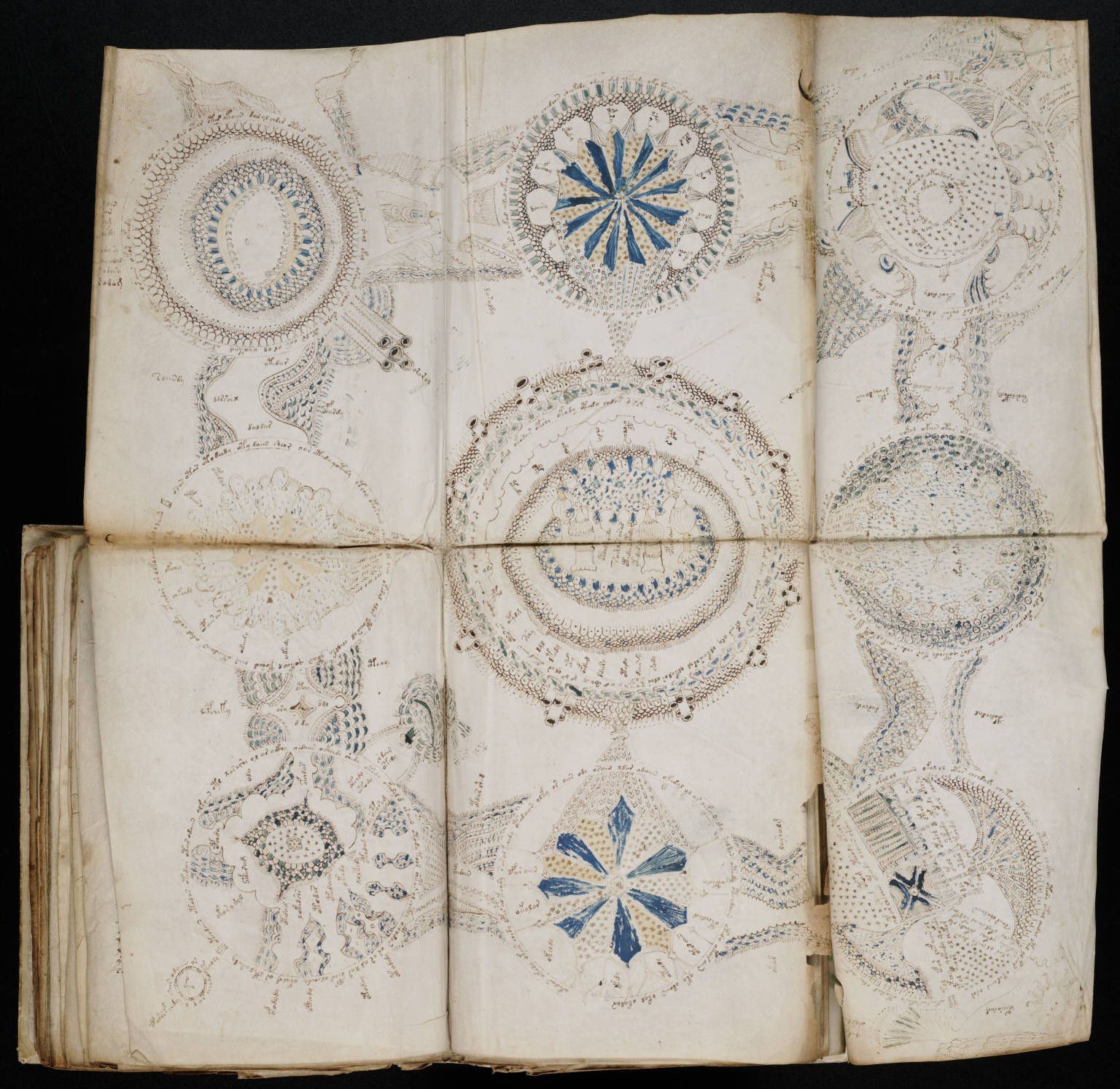
There is a book at Yale University that nobody can read. It is about 600 years old, it has around 240 pages, and it is filled with some 170,000 characters written in an alphabet that appears nowhere else on Earth. The pictures show plants that do not exist, star charts that match no known sky, and small women bathing in green pools joined by pipes. The best codebreakers of two world wars tried to read it. They all failed.
Now a new study, published in October 2026, offers a fresh explanation: we may have been reading it in the wrong order all along. The researchers say someone who could not read the script bound the book wrongly centuries ago, scrambling its pages. Fixing the order, they argue, may be the first real step toward finally reading it.
What is the Voynich manuscript?
The book is officially catalogued as Beinecke MS 408, after the Beinecke Rare Book and Manuscript Library at Yale University, where it has been kept since 1969. It measures about 23.5 by 16.2 centimetres — roughly the size of a modern hardcover — and it is written on vellum, prepared calfskin. The text runs left to right in a flowing hand, in a script researchers call Voynichese. It uses between 24 and 30 letter shapes, and the whole book holds about 35,000 words.
Nobody knows who wrote it, where exactly it was written, or what it is for. The illustrations give the only clues, and they divide the book into sections. The largest part, about 126 pages, is herbal: drawings of plants, most of which match no known species, each with a few lines of text beside it. Then come 17 astronomical pages, full of circular diagrams and 12 zodiac charts, each ringed by 30 small female figures. Another 20 pages show small nude women bathing in pools joined by pipes. There are also cosmological diagrams, pharmaceutical drawings of jars and roots, and pages of dense text that look like recipes.
The most famous image is a foldout spanning six pages, known as the Rosettes folio: nine circular diagrams — “islands” or “rosettes” — connected by causeways, with castles inside them and what might be a volcano. Nobody knows what it is a map of. It may not be a map of anything.
A new study says the pages are in the wrong order
The new research comes from Lisa Fagin Davis, executive director of the Medieval Academy of America, and Colin Layfield, an information systems researcher at the University of Malta. Their paper, “Singulion Structure and the Voynich Manuscript”, appeared in the journal Digital Medievalist on 19 October 2026.
Davis had already shown, in a 2020 study, that five different scribes wrote the book — five distinct handwritings, each working on different pages. In a normal medieval book, a single scribe writes a whole section, called a quire: several large sheets folded and nested together, then sewn along the spine. But in the Voynich manuscript the handwriting changes from page to page in ways that make no sense. As Layfield put it, a single scribe writing one quire is simply how medieval books were made — and this book does not work that way.
Davis and Layfield argue the book was never meant to be bound in quires at all. Instead, they say, it was made as separate folded sheets — each a single sheet folded in half to make four pages, called a singulion — meant to be read one after another, like a stack of small booklets. Someone who could not read the script, probably centuries ago, forced those loose sheets into a conventional binding and scrambled their order.
They tested the idea with statistics, using a method called latent semantic analysis, which compares blocks of text to find hidden patterns. Pages sitting next to each other in the book today show very low similarity, while some widely separated pages match each other closely. They ran the same tests on known medieval books, including the Aberdeen Bestiary, to check the method. The physical evidence points the same way: a large water stain does not line up from page to page, and several illustrations run off one page into the gutter and reappear pages later.
The authors are careful about what they have found. They claim no translation, and they do not know the original order. What they claim is that the current order is wrong, and that every study which assumed the pages were in order needs another look. “Any research that relies on the current sequence of pages needs to be revisited, since the manuscript is out of order,” Davis said. Correct the sequence, and the old linguistic and cryptographic work becomes worth trying again.
How do we know it is 600 years old?
For a long time, nobody could even prove the book was old. One popular theory said it was a modern fake, made by the very book dealer who sold it. That theory died in 2009, when a team at the University of Arizona radiocarbon-dated four samples of the vellum. All four agreed: the animal skin was made between 1404 and 1438. The date is for the parchment, not the writing — but the ink and pigments match other 15th-century manuscripts, which supports a date close to the parchment date.
The carbon date also killed the oldest theory about the book. A letter from the 1660s claimed it was the work of Roger Bacon, the 13th-century English friar, and that the Holy Roman Emperor Rudolf II had once owned it. Bacon died in 1292 — more than a century before the vellum was made — so that attribution is impossible. The Rudolf II story itself comes only from a secondhand report in that same letter, and no document proves he ever owned it.
The strange journey of the book
The first owner we can actually confirm is Georg Baresch, an alchemist in Prague, who had the book by the 1630s. In 1639 he wrote to the scholar Athanasius Kircher in Rome, asking for help reading it. Decades later, in 1665 or 1666, another Prague scholar, Jan Marek Marci, sent the book itself to Kircher with a letter repeating the Bacon and Rudolf stories.
After Kircher, the book most likely passed to the Jesuits in Rome. In 1912 Wilfrid Voynich, a Polish-born book dealer living in London, bought it from the Jesuits at the Villa Mondragone near Frascati, in Italy — and the book has carried his name ever since. In 1961 the dealer Hans P. Kraus bought it from his widow, and unable to sell it for the price he wanted, he donated it to Yale in 1969. It has left the Beinecke Library only once since then, for an exhibition at the Folger Shakespeare Library in 2014–2015. In 2020 Yale put every page online, free for anyone to study.
The codebreakers who tried — and failed
The book has defeated some of the best codebreakers who ever lived. In 1921 William Romaine Newbold, a professor at the University of Pennsylvania, announced that tiny markings inside each letter hid a text in ancient Greek shorthand, proving Bacon wrote it. Other scholars checked his readings and rejected them unanimously.
A generation later, William Friedman — one of the founders of modern American cryptology, the man behind the breaking of Japan’s PURPLE code in the Second World War — spent years on the manuscript with his wife Elizebeth, herself a formidable codebreaker, and with the British codebreakers John Tiltman and Prescott Currier. In the 1940s his team transcribed every line onto IBM punch cards so the text could be analysed by machine. They got nowhere. Friedman came to suspect the text was an artificial language, invented from scratch.
Currier did make one lasting discovery, in 1976: the text falls into two distinct “dialects”, now called Voynich A and Voynich B, which appear in different parts of the book. In 2004 Gordon Rugg showed a simple period method could produce text with similar patterns, proving a hoax was possible — not proving it was one. In 2014 Stephen Bax proposed sounds for a handful of letters, based on plant and star names, but never reached a readable sentence. In 2017 Nicholas Gibbs announced the text was abbreviated Latin and a women’s health guide; Davis answered that the result was not “Latin that makes sense”. In May 2019 Gerard Cheshire, a research assistant at the University of Bristol, claimed he had cracked it in two weeks as a lost “proto-Romance” language. Medieval scholars rejected it within days, and the university removed the claim from its website.
Through all of this, one fact has held: the manuscript has never been demonstrably deciphered, and no proposed solution has been independently verified.
Hoax, code, or lost language?
Four explanations are still on the table, and none is proven. The text could be a real language that no longer survives. It could be a cipher — a real message scrambled by a code. It could be an invented language, made up by its author. Or it could be a hoax: beautiful nonsense, designed to look like a book.
The statistics argue against pure nonsense. The word patterns behave like a real language: a few words appear constantly, most appear rarely, following the same curve found in English, Latin and Chinese, and words cluster by topic in the way real words do. The handwriting argues against a hoax too: the script flows smoothly, with almost no crossings-out, as if the writer knew exactly what to write. And the pages are worn — Davis describes the vellum as “heavily thumbed”, the texture of a book that was used often, not admired from a distance. That wear suggests a practical handbook, perhaps a medical manual, or — as Davis has suggested — a book of women’s folk knowledge, passed from one generation to the next.
The five scribes point the same way. A lone forger working in secret would be one person. Five hands, each writing whole sheets, looks like a small community making a book together — which is exactly what the 2026 study says the book originally was.
What happens now?
The 2026 study does not translate a single word. What it does is give research a new starting point: find the right order first, then try to read it. Davis and Layfield have begun trying to work out the original sequence of the sheets. If the pages can be put back the way their makers intended them, the old attempts — the codebreakers, the linguists, the computers — may all deserve a second look.
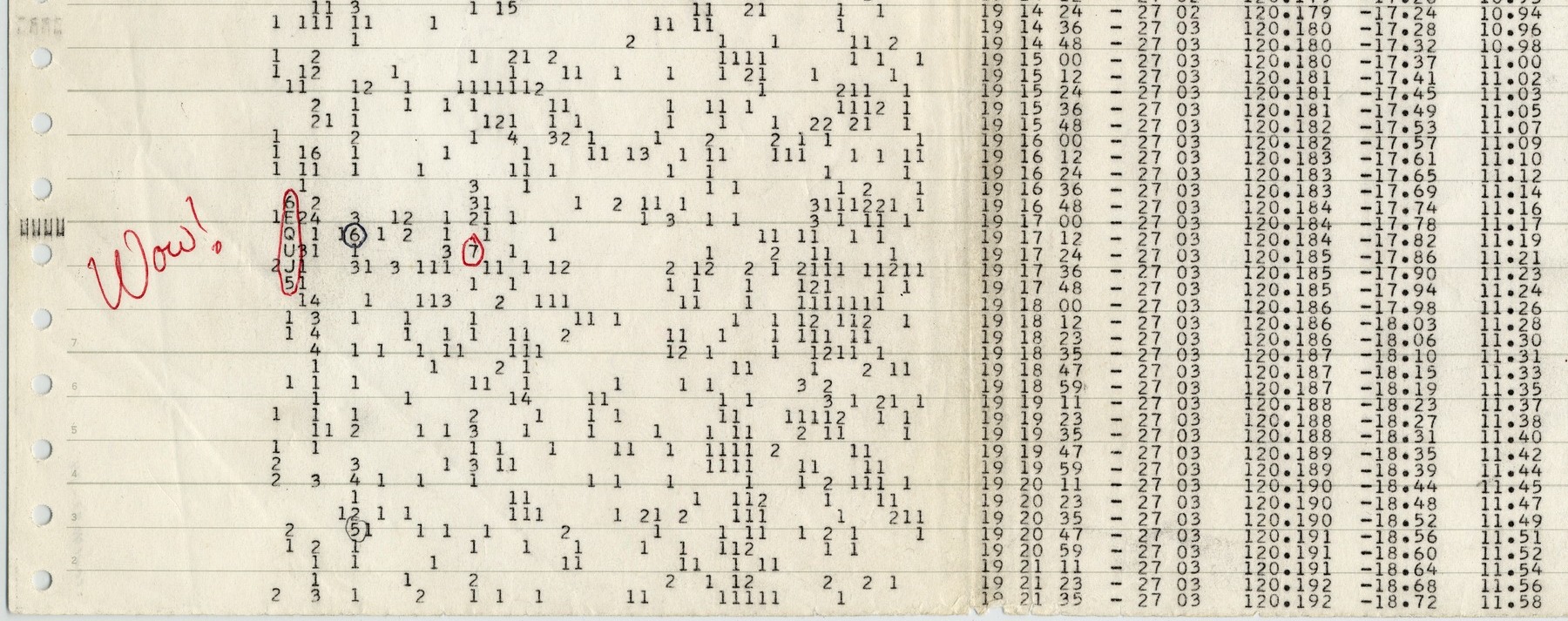
Until then, the book keeps its secret. It has outlasted its author, its owners, the codebreakers who broke real wartime ciphers, and every computer fed with its text. It belongs in the same small club as the Wow! Signal, the unexplained burst from space that was heard once and never again — a mystery where all the evidence is in front of us, and the answer is not. Like the nine hikers who died on Dyatlov Pass in 1959, the facts are all there and the explanation is still missing. The difference is that this mystery can be held in your hands. Every page is online at Yale’s digital library, free, waiting for the reader who finally understands it — or for the researcher who first puts its pages back in the right order.


Comments (0)
Comments are reviewed before they appear on the site. Your email address is never shown publicly.
No comments yet — be the first to share your thoughts.