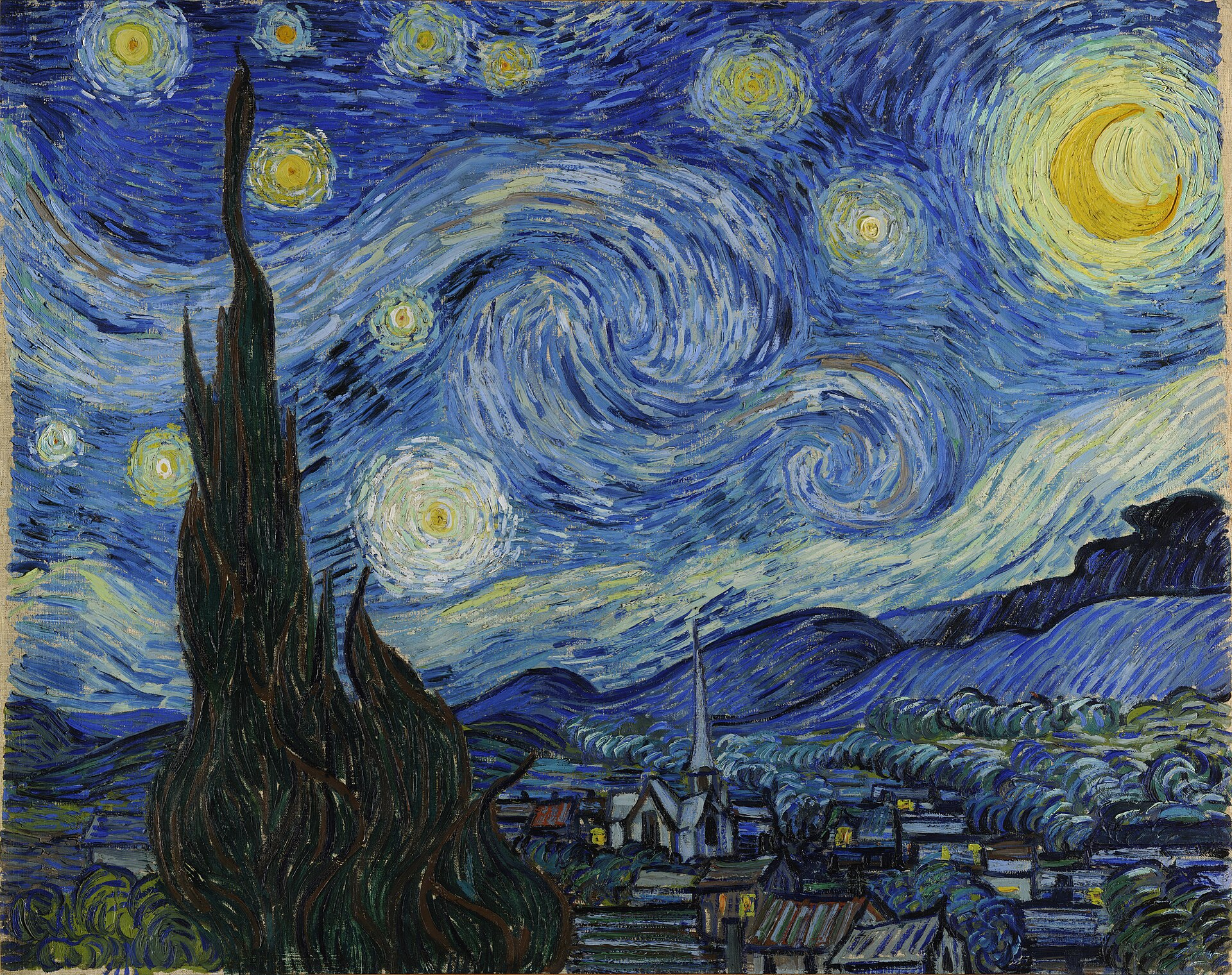
For more than a century, The Starry Night has been read as a cry from a troubled mind. But in the last twenty years, physicists have found something else in those swirls: a pattern matching, with remarkable precision, the mathematics of real turbulence — the same laws that govern a rushing river. Van Gogh painted it in June 1889. The theory that describes it was not published until 1941.
A Window, a Village That Wasn't There, and a Letter Home
Vincent van Gogh painted The Starry Night in mid-June 1889, at Saint-Rémy-de-Provence in southern France. On 8 May 1889, he had voluntarily admitted himself to the Saint-Paul-de-Mausole asylum, a former monastery, following his breakdown in Arles the previous December, when he mutilated his left ear.
The painting shows the view from the east-facing window of his asylum bedroom, just before sunrise — a view he painted in at least twenty-one variations. But The Starry Night is not a straightforward record of what he saw. It was painted during the day, in a ground-floor room the asylum's director let him use as a studio. The quiet village below the hills, with its church steeple and lit windows, could not be seen from his window at all: it was imagined, based on sketches, and its steeple resembles the churches of his native Netherlands. The great cypress in the foreground stood much further away than the painting suggests; Van Gogh pulled it close. Even the moon is not astronomically accurate, though the brightest "star" at the centre-left is Venus, the morning star — the same object Van Gogh described to his brother Theo in a letter: "This morning I saw the countryside from my window a long time before sunrise, with nothing but the morning star, which looked very big."
On or about 18 June 1889, he wrote to Theo again, almost casually: "At last I have a landscape with olive trees, and also a new study of a starry sky." That "study" is now one of the most recognised paintings in the history of Western art. It measures just 73.7 by 92.1 centimetres, and it has hung in the Museum of Modern Art in New York since 1941, acquired through the Lillie P. Bliss Bequest.
What Is Turbulence, and Why Is It So Hard to Paint?
To understand what the physicists found, it helps to know what turbulence is. Watch a river flow past a bridge, or smoke rise from a chimney, or cream swirl into coffee. The motion is not random. Big swirls break into smaller swirls, which break into smaller ones still, passing energy down from large scales to small ones until friction finally turns it into heat. This cascade is the signature of turbulence — and it follows strict mathematical rules.
Those rules were first described in 1941 by the Soviet mathematician Andrey Kolmogorov. He predicted that in a turbulent flow, energy is distributed across eddies of different sizes according to a precise law: the energy falls off as a power law with an exponent of −5/3.
Here is the puzzle. Kolmogorov's law describes real fluids: water, air, gas. A painting is none of those things. It is pigment dragged across canvas. Yet when physicists began measuring The Starry Night as if it were a fluid, the painting obeyed the law anyway.
The First Discovery: A Pattern in the Brightness (2006–2008)
The first to notice was physicist José Luis Aragón of the National Autonomous University of Mexico. Admiring the emotional turbulence of Van Gogh's late paintings, Aragón and his colleagues wondered whether the feeling of turbulence in them was more than a metaphor. Their idea was simple and clever: treat the brightness of the paint — its luminance — as a stand-in for the speed of a fluid. Then measure how that brightness changes between pairs of points at different distances apart, and compare the statistics with Kolmogorov's predictions.
In a preprint published in 2006, and then in a peer-reviewed paper in the Journal of Mathematical Imaging and Vision in 2008, the team reported a striking result. The probability distribution of brightness fluctuations in The Starry Night matched the distribution Kolmogorov's theory predicts for velocity differences in a real turbulent flow. The same fingerprint appeared in two other late works, Road with Cypress and Star (1890) and Wheat Field with Crows (1890), one of the last paintings Van Gogh made before his death at 37. The eddies come in many sizes, from the great wheeling sky down to tiny swirls made by single brushstrokes, and at every scale the statistics behave like real turbulence.
What the study does not claim matters too. It does not claim Van Gogh understood fluid dynamics, or that the painting is a turbulent flow. It shows, using a statistical model, that the distribution of light and dark across the canvas follows the same mathematical pattern as turbulence — a model-based finding that depends on treating luminance as a stand-in for fluid velocity.
The 2024 Study: Measuring Every Swirl
For years, the finding was debated. Then, in September 2024, a team led by Yongxiang Huang of Xiamen University published a study in the journal Physics of Fluids that aimed to settle the question by measuring the painting far more carefully than anyone had before.
Huang assigned the problem to his graduate student Yinxiang Ma. The team started by converting the painting to grayscale and masking out everything that did not flow: the village, the church, the mountains. What remained were the 14 main eddies of the sky. They then measured each one by hand, analysing several hundred individual brushstrokes, and quantified the brightness, width and length of every stroke. The result was remarkable: the sizes, spacing and intensity of the 14 eddies follow Kolmogorov's law with striking precision. Where the theory predicts an energy spectrum falling off with an exponent of −5/3 — about −1.67 — the painting gives −1.67 or −1.68, with uncertainties of around 0.13 to 0.19. "Our findings settle the ongoing debate about whether the dynamic sky in this renowned painting is reflective of true physical phenomena," Huang said.
But the team found something else, too. When they zoomed in below the scale of the smallest whirl, to the level of individual brushstrokes, a second pattern appeared. The brightness variations there follow a different scaling law, named after the Australian mathematician George Batchelor (1959). Batchelor's law, with an exponent of −1, describes how a passive substance — cream stirred into coffee, confetti in a gusty wind — is mixed by a turbulent flow. Seeing both patterns in one painting is, the researchers say, unusual. "The arrangement of the eddy-like formations crafted by Van Gogh resembles the energy transfer mechanism in real turbulent flows," the study concludes. Other researchers have read the sky differently: astrophysicist James Beattie has argued the swirls follow the statistics of supersonic turbulence, like the gas clouds where stars are born. That reading is contested, and it is not the one the 2024 study supports — but it underlines the point that the painted sky behaves less like decoration and more like a real physical system.
The Mind Behind the Painting — What We Actually Know
There is a story people love to tell about The Starry Night: that it is the product of madness, a hallucination painted in a fever of mental illness. The documented facts are more careful, and more interesting.
Van Gogh did live with serious mental illness — he sought help at Saint-Paul-de-Mausole himself. But no reliable diagnosis from his lifetime survives, and modern attempts to label his condition after the fact — epilepsy, bipolar disorder, schizophrenia and others have all been proposed — remain speculation, not settled fact. What the records do show is timing: according to the dates documented by the Van Gogh Museum, The Starry Night was painted in mid-June 1889, before the first of his crises at the asylum, during a period of relative stability. He was working steadily, painting the same view again and again, writing home about the morning star.
That matters, because it changes the painting's meaning. If the swirls are not the record of a breakdown, they may be the record of something else: long, disciplined looking. Van Gogh painted the sky from his window twenty-one times, in sun, wind, overcast and rain. The turbulence in The Starry Night may be less a symptom than a skill. Note that the Aragón paper framed the turbulent paintings as works made "at times close to periods of prolonged psychotic agitation" — that is the researchers' characterisation of his late period as a whole, not a documented medical fact about June 1889. The science is about the canvas, not the diagnosis.
Why It Matters: The Eye That Saw the Sky Move
So what does it mean that a painting obeys a law of physics its painter never knew? It does not mean Van Gogh was secretly a physicist. It means that careful observation can arrive at the same place as mathematics — that the patterns nature follows are visible to anyone who looks long enough, whether they carry equations or a brush.
The researchers did not set out to prove Van Gogh was a genius. They set out to test whether a painting could contain real physics, and the painting passed the test. "It reveals a deep and intuitive understanding of natural phenomena," Huang said. "Van Gogh's precise representation of turbulence might be from studying the movement of clouds and the atmosphere or an innate sense of how to capture the dynamism of the sky."
There is a lesson in that for how we look at art. A painting is not only a picture of a thing; it can be a record of how a thing behaves. The swirling sky is not just decoration around a sleeping village. Art, too, can preserve a moment the way history preserves one. Our look at Pompeii's casts tells the story of people and animals preserved exactly as they were nearly 2,000 years ago: Pompeii Casts: What They Really Are. The Starry Night has also escaped the museum wall entirely — reproduced on posters, mugs, phone cases and in video games, it is one of the most copied pictures ever made. For the modern side of visual culture, see the biggest entertainment launch in years: GTA 6 Is Out: A 99 on Metacritic, Nearly $2 Billion in Sales — and a PlayStation Network That Buckled First.
Standing in Front of It
Today, The Starry Night hangs on the fifth floor of the Museum of Modern Art in New York, in Gallery 501 — a painting smaller than a television, behind glass. Most of the people looking at it will never have heard of Kolmogorov, or of the −5/3 law. They do not need to. The painting works on the eye before it works on the mind: the sky feels as if it is turning, and that feeling is not an illusion. It is, the physicists say, the feeling of real turbulence.
Van Gogh wrote to Theo that the painting was "a new study of a starry sky". He meant it modestly. A hundred and thirty-five years later, the study is still being graded, and it keeps passing. He painted the sky as it moves. It took physics half a century to catch up with his eye.

Comments (0)
Comments are reviewed before they appear on the site. Your email address is never shown publicly.
No comments yet — be the first to share your thoughts.